
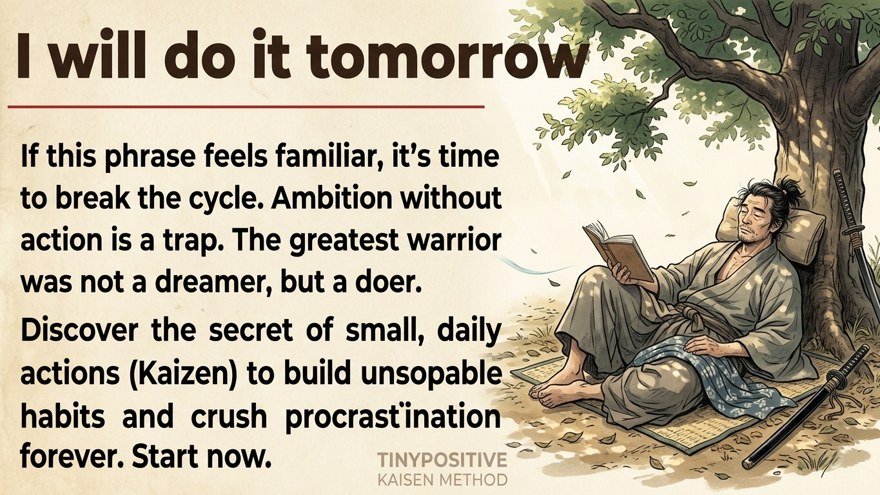

How many times have you looked at your goals — whether it’s mastering the English language or advancing in your career — and whispered the words, “I’ll do it tomorrow”?
We often treat “tomorrow” like a magical place where we’ll suddenly have more energy, more time, and more motivation. But many of us have discovered that tomorrow never really comes; It is only transformed into another today filled with the same excuses. We call this gap between our great ambitions and our actual actions “Dream Trap”.
In this post, we explore a powerful lesson from feudal Japan through the story of a young samurai named Yuki. His journey reveals a profound truth about human nature: Ambition without action doesn’t just stall our progress—it actually weakens us. The legend sees wits like swords Miyamoto Musashi and its Japanese philosophy KaizenWe’ll discover how to break the cycle of procrastination and build a foundation for lasting success.
Note from the Curator
As a technical coach and digital strategist, I’ve seen many talented individuals get stuck in the planning phase. This story is a reminder that the most sophisticated technique is useless without the humble discipline of daily practice.
Samurai and the Shadow of Ambition: Why Action Surpasses Aspiration
Once upon a time, in the misty mountains of feudal Japan, lived a young man named Yuki. Born into a clan of noble warriors, Yuki did not lack for imagination or ambition. In fact, he possessed them in abundance. He spends his afternoons perched on a stone wall overlooking the training grounds, watching senior samurai move with the fluid grace of flowing water. In his mind, Yuki was already among them. He could practically feel the weight of a katana in his hand and the roar of the triumphant crowd in his ears.
Yuki talked about his plans often and loudly. He reigned over his peers with his techniques for mastering the “Seven Star” blade technique and his theories on battlefield psychology. He read the scroll of ancient victory until the candlelight went out, making sure that his mind idea Of greatness, he was instinctively moving towards it. He believed that his fierce will was a silent engine that would eventually propel him to the top of the warrior class.
The illusion of progress
However, a treacherous gap existed between Yuki’s inner world and her outer reality. Every morning, when the wooden clapper signals the start of training, Yuki is faced with a choice. And every morning, he chose the comfort of “the perfect plan” over the grit of the practice mat.
- If it rained, he told himself, the moisture would ruin the grip of his practice sword.
- If the sun was high, he argued, training in such heat would lead to exhaustion, inhibiting his “long-term” growth.
- If he felt a slight pain in his joints, he convinced himself that rest was the most “strategic” step.
The years passed like sand through his fingers. Even though Yuki’s dream became a giant monument of fantasy, his true skill remained intact. The younger disciples—boys who had entered the dojo with half his talent but twice his tenacity—began to outshine him. They didn’t talk about grand strategy; They’re just sweating.
Eventually, Yuki was forced to face a devastating truth: His dreams did not lift him up; They anchored him. By constantly imagining his future success, his brain is receiving the “reward” hit of dopamine as if he has already achieved his goal. This phenomenon, known as “social realism,” suggests that when we share our great intentions, the mind mistakes praise and fantasy for real accomplishments. Yuki was trapped in a cycle of emotional victory and physical defeat.
Miyamoto Musashi Philosophy: Small, steady rhythms
Centuries ago, the legendary swordsman Miyamoto Musashi realized a concept that Yuki failed to see. Musashi didn’t believe in “lightning strikes” of inspiration. He realized that a warrior’s strength is not built in a moment of high-stakes combat, but in the quiet, repetitive hours of daily discipline.
“Walk step by step the road of a thousand miles.” — Miyamoto Musashi
The samurai way was built on the principle that training isn’t something you do when you’re “ready”; Training is a state. Waiting for the “right” feeling before raising the sword is as futile as a sailor waiting for the ocean to stop rolling before setting sail.
The myth of motivation
We often think of motivation as a prerequisite—a spark that must ignite before the engine of action can start. But the samurai knew the opposite was true: Action is the spark that creates the flame of motivation.
When you act without feeling like it, you create momentum. Momentum creates a sense of competence and that competence eventually creates the “motivation” we’ve been waiting for in the first place. People who reach the peak of their potential are rarely the most “inspired” people in the room; They are the only ones left in the way when inspiration evaporates.
Kaizen Nomi: The Power of Small Improvements
Ancient teachers taught this concept Kaizen noSmall, continuous improvement paths. They compared the path to mastery to climbing a mountain. If a climber spends all their time staring at distant, snow-capped peaks, they are overwhelmed by the sheer scale of the journey. They feel small, tired and defeated before they even start.
But if the climber focuses on the six-inch rock in front of them, the mountain eventually disappears. Only step left.
The Tale of the Single Sword Form
Imagine two students. The first student refused to train unless he could commit to four hours of intense sparring. Because her life is busy and her energy fluctuates, she can only train once every two weeks.
The second student feels similarly exhausted and unmotivated. However, he commits to a “non-negotiable” rule: he will practice a single sword form – a movement – for five minutes every morning, regardless of his feelings.
- Month 1: First student trained for 8 hours. The second student trained for 2.5 hours. The first student feels superior.
- Month 6: The first student missed several weeks due to “burnout” and “lack of motivation.” The second student did not miss a day. His muscles have developed “memory”. Movement is now automatic.
- Year 1: The second student laid the foundation of iron discipline. Because the small task was so easy to start, he often found himself staying for thirty minutes after starting. He has now bypassed the first student, who is still waiting for a “free weekend” to get back in shape.
Overcoming “Resistance”.
Our work avoidance often stems from a fundamental fear of discomfort. We fear “beginnings” because beginnings require us to face current inadequacies. Yuki avoided training because, on the mat, he wasn’t “the greatest fighter in the land”—he was just an apprentice who struggled with his footwork.
Discipline is an act of movement through That resistance rather than trying to eliminate it. Yagyu Munenori, a renowned teacher of the shoguns, famously noted that a sword that waits for perfect condition eventually rusts inside its sheath.
Shift from feeling to commitment
To bridge the gap between wanting and doing, one must adopt a new inner dialogue. Most people operate in a “feel-based” system:
- “I don’t want to work today, so I’ll skip it.”
- “I’m not in a creative mood, so I won’t write.”
Samurai operates on a “promise-based” system:
- “I’m a person who trains every day. My feelings are irrelevant to my identity as a fighter.”
This change is profound. This removes the “discussion” phase from your brain. When you stop asking yourself if When you feel like doing the work, you actually release a lot of mental energy to do work
way ahead
Yuki’s story serves as a timeless warning. Ambition is a beautiful compass, but it’s a terrible engine. If you find yourself stuck in the “dreamer’s trap,” the solution isn’t more planning, more reading, or more soul-searching.
The solution is Shrink the target until the resistance disappears.
If you can’t write for an hour, write a sentence. If you can’t study for certification, read a paragraph. If you can’t manage a complex project, organize a folder.
Do not put your trust in the passing winds of emotion. Instead, build your house on the rock of habit. As ancient warriors whispered to their disciples: “I am not governed by my feelings, I am governed by my promises.”
Real strength is not the absence of laziness; Laziness is the ability to work while still sitting on your shoulders. The sword is in your hand. The weather will never be perfect. get started
Frequently Asked Questions (FAQ)
What is the “dream trap”?
The “dream trap” occurs when a person finds more comfort imagining their future success than enduring the discomfort of daily practice. It creates a gap between what is desired and what is actually willing to do. In fact, the more someone talks about their plans without acting on them, the more their mind rewards them as if they’ve already achieved something, making dreams themselves a trap that leads to inaction.
What is Kaizen Method?
The samurai held the principle of kaizen nomi, which translates as “the path of small improvement”. It teaches that greatness is not created through sudden bursts of energy, but through the quiet rhythm of repetition and small, steady actions performed every day. The philosophy suggests that even if progress seems slow or the steps seem small, they lead to strength and mastery because they are repeated and never stopped.
Why is “waiting for inspiration” considered a mistake?
Waiting for inspiration before starting is likened to waiting for perfect weather before setting out on a journey; You can wait forever for others to reach their destination before you. Inspiration is often not the spark that creates action, but the flame that follows it. Action brings momentum, and that momentum creates energy that people often mistake for motivation.
How is discipline different from motivation?
Discipline is not about avoiding feelings of exhaustion or lack of energy; It’s about moving through them. Real strength is defined as the ability to act when the situation is not perfect, rather than acting when you feel ready. As the ancient warriors practiced, it means being guided by commitment rather than being controlled by fleeting feelings.
How can I apply these lessons to learning English?
To acquire a skill like English, you shouldn’t wait to feel “ready” because readiness is often an illusion. Instead, you should rely on your habits and small daily actions. For example, a student may only practice a single form or learn a small amount each morning; Over time, these small efforts build a foundation that makes learning advanced skills much easier.
Conclusion
The lesson of the samurai is clear: strength lies not in feeling “ready,” but in acting despite the resistance of laziness or fear. Preparation is often an illusion that keeps us going while others, who are willing to “walk in the rain,” reach their destination before us.
To bridge the gap between wanting and doing, you need to stop relying on fleeting emotions and start putting it into practice. Habits and commitments. Remember its principle Kaizen no: Focusing on a single step directly in front of you, rather than looking at a mountain peak.
Your small step today: Don’t wait for tomorrow. Choose a small task—learn a new English word, write a paragraph, or spend five minutes on your most important task. As the ancient warriors said, “I am not governed by my feelings, I am governed by my promises”.
What is one “small step” you are taking today? Share your pledge in the comments below. Let’s stop waiting for tomorrow together.