
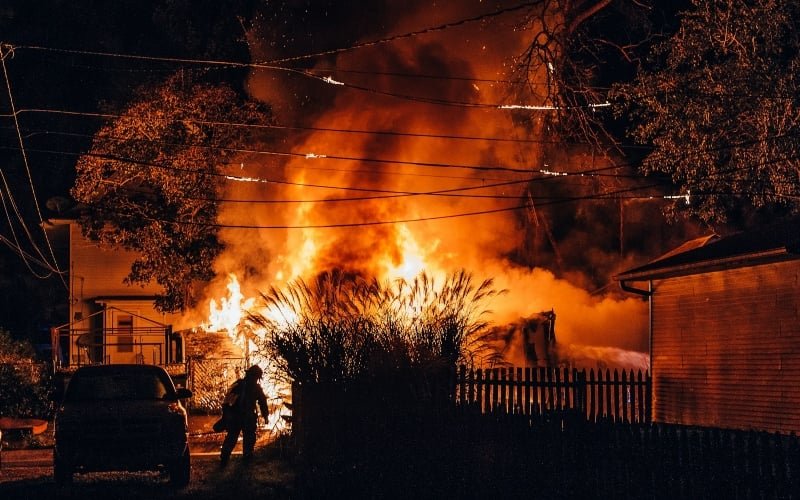


The wildfires that burned L.A. in January 2025 weren’t just a climate disaster. As the disaster unfolded, what people needed most was accurate evacuation information and safety guidance, but social media spaces were simultaneously flooded with “false masquerading as information.” For example, claims that the Hollywood sign is burning, along with fake AI-generated images, spread quickly, forcing the media to Fact-check Their LA fires showed that misinformation during climate disasters is not just online confusion, but a problem that fuels distrust and attacks on experts, undermines their public discourse, and ultimately threatens citizens’ safety and access to accurate information.
In the moment of climate catastrophe, facts are no longer the subject of general debate. It’s a lifeline that determines whether people move, which path they take, how they perceive risk, and whether their families stay safe. That’s why, during the LA wildfires, disaster agencies and government authorities not only had an emergency response on the ground, but Communication work At the same time to manage rumors and misinformation. At the federal level, guidelines Even during the fire government websites and social media were issued to coordinate communication, which itself shows that the information environment is considered as part of public safety. Protecting expert discourse against misinformation during climate disasters is a minimal state obligation to protect citizens’ rights to life and information.
How misinformation drives out experts
Complex climate disasters like the LA wildfires cannot be fully understood without expert explanation. In particular, issues such as fire spread and response, water supply systems, and hydrant failures require an understanding of both technical causes and infrastructural limitations, yet these complex realities are easily reduced to simplistic frames in social media. In fact, the LA Department of Water and Power was direct correct incorrect information Around the water system after the fire. Public media Fact-check Also shows that false claims about the LA wildfires and California’s water policy are widespread among the public. In disaster situations, expert discourse is not only a supplementary explanation, but an important basis that allows citizens to make safe decisions.
But the real problem is that this misinformation doesn’t just stop at spreading lies. This undermines trust in experts and institutions in the public sphere and creates an environment in which “even the experts cannot be trusted.” As conspiracy theories spread, experts and government authorities trying to explain the truth were transformed from trusted providers of information to targets of attack and ridicule. The fact that the California state government produced materials responding to false claims about water in its format “Experts Telling the Real Facts” also suggests that an environment had developed in which expert discourse could no longer be delivered naturally, but instead required refutation and defense.
In this environment, stress experts believe that mere psychological distress does not exist. Frequent online harassment creates a chilling effect that weakens the willingness of experts to speak out. According to a Global Witness Survey39 percent of climate scientists who responded have experienced online abuse or harassment because of their climate-related research and public speaking. Among scientists with frequent media exposure, this number rose to 73 percent. More alarmingly, 41 percent of respondents who experienced abuse said they later reduced their social media postings about climate issues. In other words, the more misinformation spreads during a disaster, the more limited the space needed for expert voices to respond.
Right to reliable information
When experts are pushed out of the public, the biggest victims are not the experts, but ordinary citizens. Of course, citizens are also agents of information who can generate important clues for disaster response through eyewitness accounts and local community experiences. However, when they are forced to assess danger while surrounded by rumours, manipulated images and simplistic political frames, the quality of decisions directly related to their safety is inevitably diminished. Especially in the early stages of a disaster, when there is a large information gap, fast-moving content dominates public perception. recent Academic research Analyzing social media discourse also illustrates that misinformation in disaster-related content can significantly shape public discourse and, as a result, citizens risk being guided less by “what is true” than by “what is spreading more widely.” Ultimately, this goes beyond the capabilities of disaster response and becomes a problem where the information base citizens need to protect themselves is destabilized.
If experts and citizens cannot trust each other, the information needed during a disaster becomes a void that no one shares responsibly. Therefore, responding to misinformation during climate disasters should not only be seen as a content management issue, but as a human rights issue. The right to access reliable information during disasters is not only fundamental to sustaining personal life and safety, but also a prerequisite for the exercise of other rights necessary to protect one’s health, mobility and housing. International human rights discussions are also moving beyond the view that climate data is merely reference material. D Report of the OHCHR Special Rapporteur (A/79/176) Emphasizes that access to information on climate change and human rights is a prerequisite that enables transparency, inclusion and effectiveness. From this perspective, governments, platforms and media have a responsibility not only to fact-check and moderate content during disasters, but also to prioritize the visibility of verified experts and government institutions and to establish minimum safeguards that can quickly respond to harassment and threats targeting experts.
The lesson shown by the LA fires is clear. When misinformation makes experts targets of distrust and attack and undermines their public discourse, the public is ultimately pushed further away from life-saving information at the moment they are most vulnerable. Therefore, responding to climate disaster misinformation must mean preserving an information environment where expert opinion can survive, to ensure citizens’ safety and access to information. In an era of climate crisis, resilience ultimately starts with protecting those who speak the truth from being silenced.
–
Previously published Reprinted on and with resilience permission
Join The Good Men Project as a Premium Member today.
All premium members Watch the Good Men Project without any ads.
–
Image: splash



