


There’s a version of pain many single fathers learn to hide so well that even those closest to them can’t quite see it.
It doesn’t always look dramatic.
It often looks responsible.
A man is still going to work every day while mentally breaking down internally. A father shows up for his kids while calmly working on three hours of sleep and chronic stress. A man sits alone in a parked car after trying to control his emotions before heading home to family court. A father pretends he’s “good” because bills still need to be paid, schedules still need to be managed, and kids still need stability.
For many single dads, survival becomes automatic.
And somewhere inside that survival mode, mental exhaustion slowly becomes dangerous.
A part that society rarely discusses honestly.
The suicide crisis among fathers, divorced men, and overwhelmed single fathers is real, growing, and widely discussed.
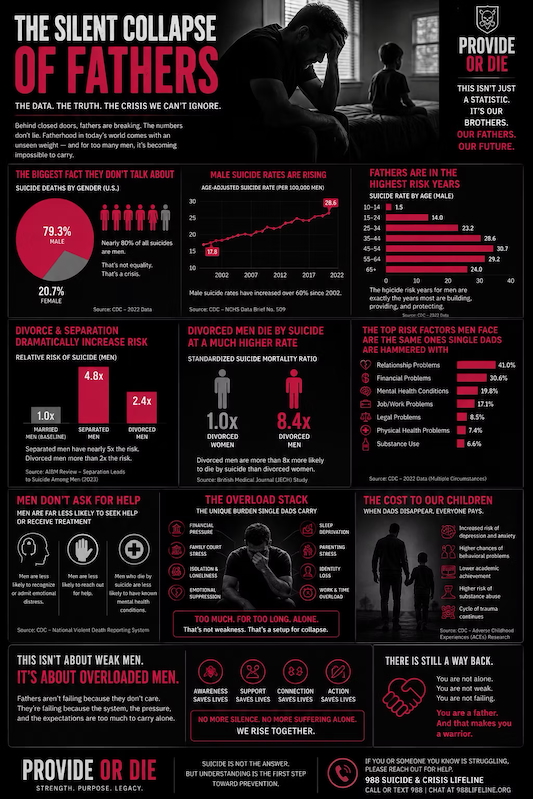
According to American Foundation for Suicide PreventionMales account for nearly 80% of suicides in the United States, with male suicide rates dramatically higher than female suicide rates year after year.
But when researchers began examining divorce, separation, custody stress, separation, and relationship breakdown, the numbers became more alarming.
Published in research Journal of Epidemiology and Community Health Divorced men are significantly more likely to commit suicide than divorced women and married men.
An additional large-scale review found that separated men face nearly five times the risk of suicide compared to married men, with young recently separated fathers facing some of the highest risk levels ever recorded.
And yet despite these numbers, many single fathers still suffer in almost total silence.
Why are so many single parents emotionally trapped?
Single parent burnout Rarely comes from one thing.
It comes from accumulation.
I’ve spent years talking openly about the emotional burden many fathers carry in silence.
I describe modern single parenthood as “survival mode extended over the years.”
This phrase resonates deeply because many fathers do not describe themselves as depressed.
- They describe themselves as
- Tired.
- numb
- overloaded.
- Disconnected
- heavy
That language is important.
Because many men never seek help when their mental health deteriorates. Instead, they internalize stress and continue working until emotional shutdown becomes dangerous.
Research surrounding relationship breakdowns repeatedly shows that loneliness, isolation, shame, custody conflicts, unemployment, and emotional repression are major contributors to suicide risk among men.
For single fathers, these pressures often occur simultaneously.
The family court factor no one wants to discuss
One of the strongest recurring themes across research involving divorced fathers and suicide risk is separation from children.
For many fathers, custody battles are more than just legal disputes.
They feel existence.
Many men describe family court as living in constant uncertainty.
Each hearing is affected by:
- Parenting time
- financial
- Housing
- schedule
- identity
- Mental stability
- Relationship with children
Some researchers estimate that family breakdown contributes to a significant percentage of middle-aged male suicides.
Other studies have shown that divorced men are nearly three times more likely to commit suicide than married men, suggesting that separated men may be at greater risk.
The emotional reality is devastating for many fathers because society often expects men to absorb a lot of emotional damage while remaining fully functional.
Bills still need to be paid.
Children still need to be picked up.
Work still expects productivity.
The world rarely makes a break for overwhelmed fathers.
Financial stress is breaking fathers’ silence
One of the least discussed areas of male mental health is the stress of financial survival.
Single fathers often carry:
- Child support
- Attorney’s fees
- Housing costs
- loan
- Inflationary pressure
- Job instability
- Emergency expenses
- Parental responsibility
A time to emotionally rebuild after a breakup or divorce.
The nervous system eventually begins to operate in constant fight-or-flight mode.
Sleep is impaired.
Patience is lost.
Isolation increases.
Relationships become difficult.
Many fathers stop thinking about peace.
They only think about survival.
Aaron Nolan talks about this mental shift often in PROVIDE OR DIE because financial stress is the most powerful burnout trigger affecting modern fathers.
And unlike temporary stress, years of survival mode can fundamentally change mental health.
Why men are silent until they fall
One of the most dangerous parts of the single father’s mental health crisis is that many fathers become extremely skilled at hiding distress.
Men are often conditioned to:
- Suppression of emotions
- Avoid weakness
- “man up”
- keep working
- Stop complaining
- Push through the pain
But emotional repression does not eliminate suffering.
It buries.
And suppressed pressure often resurfaces later:
- anger
- numbness
- addiction
- mental closure
- panic attack
- hopelessness
- suicidal thoughts
According to suicide prevention organizations and mental health researchers, isolation and lack of emotional support are major risk factors for men in crisis.
That’s why Aaron Nolan made PROVIDE OR DIE different from traditional parenting websites
Not as another polished self-help platform.
But as an emotionally honest support ecosystem for fathers who feel they are carrying too much alone.
The internet rarely speaks honestly to fathers
Most online mental health content seems clinical, aimed at men.
Generic
Emotionally disconnected.
But dads are searching for phrases like:
- “Single Dad Burnout”
- “Why am I angry all the time”
- “Family Court Ruined My Mental Health”
- “Single Dad Tired”
- “I feel numb after the breakup”
- “Why Dad Feels Lonely”
- “Financial stress is destroying me”
…not usually looking for motivational slogans.
They seek recognition.
They want someone to finally say: “This pressure is real.”
What dads need before a crisis hits
Most single dads don’t need judgment.
They need a support system.
They need:
- emotional integrity
- community
- Practical Guide
- Financial structure
- Nervous system recovery
- real conversation
- connection
- stability
Most importantly, fathers need to understand that struggling under too much pressure does not make them weak.
This makes them overloaded people who carry more than most people realize.
That difference can save lives.

Frequently Asked Questions About Single Dad Suicide, Burnout, and Emotional Overload
Why is the suicide rate of men so high?
Men are responsible for nearly 80% of suicides in the United States. Research shows that isolation, emotional repression, financial stress, divorce, unemployment, legal stress, and lack of support systems all significantly increase the risk of suicide for men.
Are single fathers at higher risk of depression and suicide?
Many single fathers experience multiple major stressors simultaneously, including financial stress, family court stress, emotional exhaustion, loneliness, parenting stress, and loss of identity after divorce or separation. This combined stress can dramatically increase emotional distress and burnout.
Why don’t more parents want help?
Many men are conditioned to suppress emotional pain rather than talk openly about it. Many fathers are afraid of appearing weak, losing respect, losing custodial credibility or becoming a burden to others, so they suffer in silence for years.
What does single parent burnout really feel like?
Single dad burnout often results in chronic fatigue, irritability, emotional numbness, depression, anxiety, survival mode, overthinking, isolation, and feeling emotionally disconnected from life. Many fathers continue to function externally while struggling internally.
Can divorce and family court increase the risk of suicide?
Research has consistently shown that divorce, separation, prolonged legal conflict, financial stress and social isolation are major risk factors for suicide for men. Many fathers describe the stress of family court as the most emotionally draining experience of their lives.
Why do many fathers feel emotionally numb?
Chronic stress and emotional overload can push the nervous system into survival mode. Over time, many men stop feeling emotionally connected, motivated, excited or optimistic because their minds and bodies are completely focused on survival.
What are the warning signs that a father may be struggling emotionally?
Common warning signs include:
- Extreme fatigue
- mental closure
- Anger and resentment
- separate
- hopelessness
- Loss of motivation
- Talking about getting stuck
- Withdrawal from friends and family
- Increased substance use
- A sense of understanding
What actually helps burnout dads recover?
Recovery often begins with:
- Reducing isolation
- Construction support system
- Improves sleep and health
- Finding purpose again
- Rebuilding financial stability
- emotional integrity
- Community Connections
- daily composition
- Small progress
Most dads don’t need too much pressure. They need support, purpose and a reason to keep building.
Is burnout the same as depression?
Not always. Burnout is often associated with chronic overload and chronic stress exposure, while depression can involve deeper psychological and biological causes. However, the two can overlap a lot, especially among fathers who experience years of emotional and financial stress.
What should someone do if they are having suicidal thoughts?
If someone thinks they may harm themselves or are experiencing suicidal thoughts, they should contact emergency services, a mental health professional or a crisis support line immediately.
In the United States:
Call or text 988
The Suicide and Crisis Lifeline is available 24/7.
No father should bear this burden alone.
–
This post was Previously published in Provide or Die.
***
You might also like this from The Good Men Project


If you believe in the work we’re doing at The Good Men Project, please join us as a Premium Member today.
All premium members can watch The Good Men Project without any ads.
Need more information? A full list of benefits is here.
Photo credit: iStock