
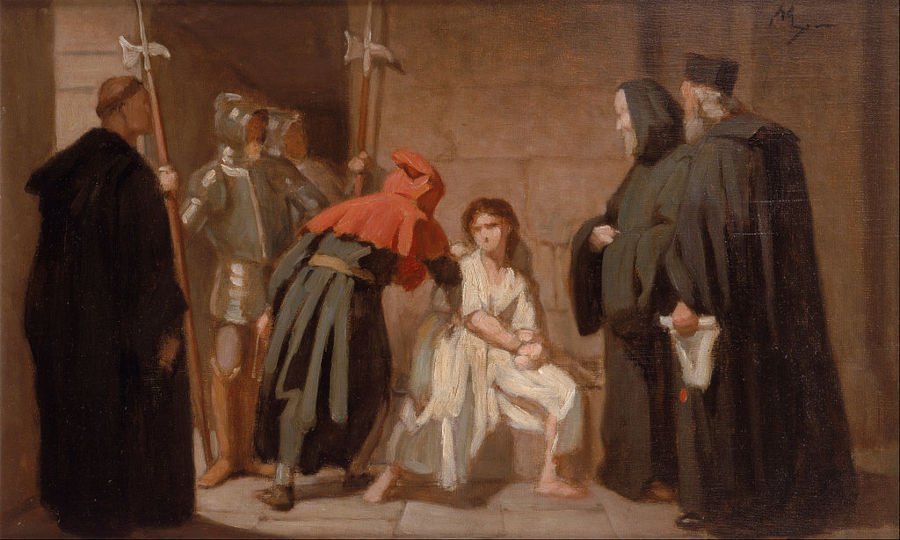

During the Middle Ages, the Church exercised great influence over the affairs of the state and over the lives of the people. In many cases, it holds the same power as the government and royalty. Although the common people were not able to fully appreciate the nuances of state and social affairs in which the Church saw fit to involve itself, the masses followed the instructions of the clerical class when it came to various matters of right and wrong.
In this paper, we will take a closer look at what the Church’s position was about magic. The Church will determine what represents a danger to society, what should be avoided and, consequently, what will be persecuted and punished. Although this position varied somewhat depending on the clergy and theologians in charge of the Church’s doctrine, the general strains persisted throughout and retained their relevance.
Demonic and natural magic in the medieval period
As defined by theologians and intellectuals of the time, magic fell into two categories determined by the type of power at its core. Natural magic would be classified as any phenomenon attributed to the natural forces or physics of nature. In contrast, demonic magic relies on the invocation of supernatural or occult forces for its power.
The demarcation between the two was not clear, especially in the early period when mankind’s understanding or appreciation of the natural sciences was in its infancy. The Church initially considered both forms of magic equally harmful and to be avoided. Early Christians had a limited sense of what was naturally possible and considered everything beyond their narrow understanding to automatically fall into the category of magic.
Tatiana was a Christian theologian and author, who titled his work ‘Address to the Greeks‘ (Oratio ad Graecos), maintained that all magic was demonic. He hypothesized that items such as amulets and herbs had no inherent power but gained efficacy through the manipulation of demonic powers in an attempt to enslave humanity and turn it away from God.
The Judaic congregations (Christians and Jews) believed that demons were fallen angels who wanted mankind to obey them in their disdain for God. Apart from Tatian, other prominent theologians believed along the same lines.
There is a course in the title “The Witch Trials” From Center of Excellence. Click here for details (Aff.link). You can use our code “Light Battlefield 466” for 70% off
John ChrysostomFor example, would harshly rebuke women who sought the aid of magical influences in their efforts to heal their sick children or instead of following accepted Christian channels to conceive. This was part of a larger consensus that saw women as particularly susceptible to the lure of magic.
TertullianFamous philosophers, say that demons taught witchcraft to women (Herbal remedies mainly) due to their receptiveness or susceptibility to fraudulent overtures evil being
It is noteworthy that these voices would admit that the herbs and remedies in question had the power to bring about real results. However, they disputed that this knowledge was given to practitioners by evil spirits or ghosts. Thus, this knowledge automatically falls into the category of demonic magic.
Augustine of Hippo Arguably the most significant influence on medieval Christian attitudes towards such matters. In his best-known work,’city of god‘ (Civitas Dei), he sought to answer the claim that conversion to Christianity had led to the fall of the Roman Empire.
As he saw it, pagan Roman traditions rooted in occult practices such as necromancy were the real cause of its downfall. He believed that demons would instruct people in the use of stones, plants, charms, animals and other powerful objects and then use these objects as vehicles to carry out their magical activities.
Related reading: The Witch Stereotype and Crimes of Witchcraftt – Opens in new tab
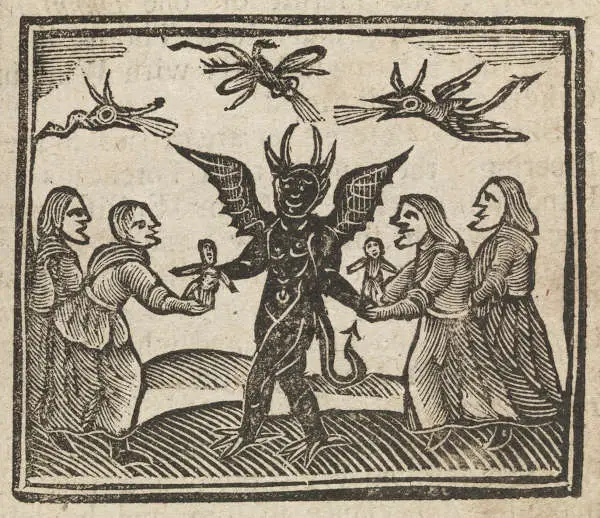
Even though he acknowledges the natural powers of natural objects or phenomena such as magnets and herbal remedies, he maintains that evil spirit Yet lies behind them. With the growth of the Church, ecclesiastical laws were enacted condemning magic, however Canon Law It is already banned.
In the town of Elvira, a Synod held in 306 AD A decree passed against those convicted of killing others through witchcraft (‘maleficium’). For the sin of invoking evil spirits, considered a necessary element of such activity, they even forbade them to receive communion while lying on their deathbeds.
Although Roman law had hitherto only punished magic users for harmful activities, the growing dominance of the Church (as emperors converted to Christianity) saw the laws expanded to punish all forms of magical activity. Such legislation can be seen Theodosian Code 439 AD and The Justinian Code 529 AD.
As Rome fell, a centralized authority began to decline in Europe, and subsequent cultural changes began to assert themselves, the prevalence of the Greek language and its literature declined. Regional dialects became widespread, and Latin survived as the preserve of the educated classes of the domineering aristocracy.
Christianity would begin to incorporate elements previously found only in pagan or pre-Christian societies to accommodate the changing demographic landscape, even as they spoke out against magic.
Historians can track different types of magic during this period by studying the manuals used by the confessors punishment. Appropriate penances for the offending person to perform are listed in this volume as well as various types of magic.
For example, one has to perform a special penance to accept ‘Shaitan Mantra’. However, the priest or confessor would still hold the position that magic has no power to influence people, change the weather, evoke love, or otherwise challenge their belief in God’s omnipresent order of the universe.
Even those who believed in such ideas but did not practice magic had to do penance, but the penances would only address actions rather than people’s thoughts at the time. This, however, was soon to change.
Related reading: Burning Words, Healing Bodies: How Medieval England Used the Written Word to Heal – Opens in new tab
Reduced natural magic
Early Christian theologians until the 12th century saw magic as the direct intervention of malevolent supernatural beings in human affairs. They saw magic taking various forms such as hydromancy, geomancy, pyromancy and aromancy (divination through water, earth, fire and air respectively). Also included were divination through astrology, observation of the bowels of animals and the activities of birds, and various spells and phenomena.
Changes came in the 13th century as the distinction between demonic magic and natural magic began to emerge. The Bishop of Paris, William of Auvergne, was a prominent voice alongside others such as Saint Albert the Great, the patron saint of experimental science.
New fields of knowledge also arose, including alchemy and scientific astrology, which used more rigorous methods and advanced methods while claiming ancient philosophical and scientific traditions.
Earlier cathedral schools would give rise to universities, and Arabic learning would find its way to Europe alongside Aristotelian science and philosophy. All this would greatly influence the intellectual spirit of Europe.
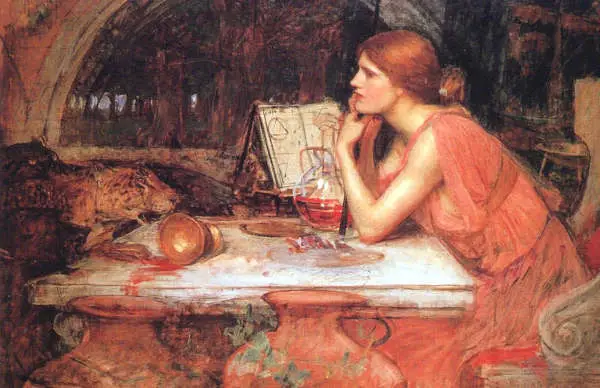
Although alchemists and astrologers did not view their practices as magic, many did until the late Middle Ages. Thomas AquinasThe patron saint of scholars, he was one of those who saw all magic as inherently satanic although refrained from using the word ‘magic’ to cover many natural phenomena such as the movements of the planets and stars. in his work’Summa against heathenss,’ he points out that this term is to be attributed only to matters of evidence of the direct intervention of ghosts.
Where his argument seemed to revert to earlier attitudes was in his claim that even events that may not have been prompted by demonic forces would still carry their stigma. Because these practitioners receive their superhuman knowledge from some kind of supernatural being.
Early Christian theologians continued to warn against the invocation of evil spirits until the late Middle Ages as the fear of magic reached a fever pitch. Yet, granting too much power to the power of demonic forces to influence the natural world was risky. The problem lay in allowing their power without departing from God’s position as the prime mover of all creation.
Related reading: “The Medieval Witch Trials in Europe”.– Opens in new tab
Superstition and Magic in the Middle Ages
Riddles gave birth to words ‘Superstition,’ which was used to include all charms, gestures, words or practices which, although they may not prove direct satanic action, were nevertheless inspired by them and thus sinful. These include what were once widespread pagan practices such as medicinal herbs, offerings, curses, and rituals associated with natural phenomena such as springs and wells.
While laws against such acts sought to punish practitioners in relation to observable harm to others, the Church sought retribution for the offense against God that such practices represented.
Nevertheless, secular and ecclesiastical authorities had limited success in eradicating the practice of witchcraft among the populace. As the Dominican and Franciscan friars rose to prominence as preachers, the question of magic would be a frequent theme for their sermons.
Franciscan missionaries Bernadino of SienaSadhu, the patron saint of advertising, would play an important role in developing a system that would prove to be one of its most effective methods. Witchcraft and the persecution of its practitioners. The medieval inquisitors who would staff this system would serve as flag bearers or would prove to be the darkest chapter in church history.
Do you want to know more about Magick? Check out our recommendations atThe Magic BookshelfAnd many free resources at our “Free Magic Library“
Featured Image: Edward Moyse – The Inquisition. From Wikimedia Commons