


“When you say yes to others, make sure you don’t say no to yourself.” ~Paulo Coelho
I grew up as the first-born girl—responsible, helpful, who didn’t want to cause trouble. I learned very quickly how to be “good”. Good means calm. Good is simple. Good means not much needed.
I didn’t realize then that I was learning how to abandon myself.
School was hard for me in ways I don’t know how to explain. I struggle with reading. I struggle with focus. I struggled to keep up—especially compared to my younger sister, who could read something once and seem to understand it immediately.
I studied late. I rewrote the note. I worked twice as hard to get half as far. No one ever said the words dyslexia or ADHD to me. Back then, girls like me didn’t have ADHD—we were labeled as sensitive, distracted, anxious, dramatic, impulsive, or “just didn’t work hard enough.”
So I tried more. I pushed I worked extra. I internalized the belief that there was something flawed about me—that ease was for other people. And since I was the oldest, I didn’t want to be difficult. I didn’t want to be the problem. So I worked quietly. I struggled in silence. I have remained small in my needs.
Sacrifice does not begin with dramatic sacrifices. It starts with the small moment of choosing everyone else’s comfort over your own truth. By the time I became an adult, that pattern was deeply entrenched.
Then I got pregnant for the first time. I didn’t tell many at first. I was cautious in my pleasure. Be careful. Quietly optimistic.
When I miscarried, the loss felt invisible to everyone but me. There were no baby showers to cancel. There are no nurseries to break into. Just an empty space where a future lived briefly.
I told myself to go ahead. I told myself it was “not the same” as losing a child. I told myself not to make a big deal out of it. But grief that is not felt does not disappear. The body is buried.
After a while, I got pregnant again. And then again. When I became a mother, I already knew how to override my own fears. How to work through the pain. How composed when everything inside me trembled.
When my first child was born, I didn’t say, “I’m overwhelmed.” I said, “I got it.”
When my second child arrived too early and was rushed straight to the NICU, I didn’t say, “I’m terrified.” I said, “Tell me what to do.”
When my body began to break down under the weight of stress, fatigue, and fear, I didn’t say, “I need help.” I said, “I’ll push.” That’s what firstborn daughters do.
We choose harmony over integrity. We prefer need over want. We choose peace—even when it costs ourselves.
The NICU days blur together. Hospital parking tickets. Beeping monitor. wires and alarms. A breast pump on the kitchen counter. A child at home needs dinner and bedtime stories. And since I wasn’t eligible for vacation and couldn’t afford not to work for myself, I went back to my job almost immediately.
I had no choice. I used up my vacation, my wife was still in college, and I was the only thing standing between my family and complete financial distress. I had income. I was insured. So I carry it all.
Over the years, I’ve found myself managing it. But inside, I was frying on the edge.
Every January – the anniversary of that injury – my nervous system would just burn out. I told myself I had “seasonal depression” or just a “bad winter,” but the truth was that my body was keeping track of everything my mind was too busy to process.
Trauma doesn’t always look like a dramatic flashback. Sometimes it’s a quiet, relentless obsession with keeping everything “just right” because you’re terrified that if you let go of a thread, the whole world will end. Finally, that bill comes due. You can’t disappear to everyone else and expect to come back to yourself.
Eventually, the cost of self-abandonment becomes impossible to ignore. Burnout settled into my bones. Anger simmered under my skin. Resentment followed me like a shadow.
Change for me didn’t happen in one dramatic moment. It happened a thousand times – every time my body told me to slow down and I ignored it, until it stopped whispering and started screaming.
The true value of this “reliability” became horribly apparent during my second pregnancy. I was in a hospital bed, physically fragile under the weight of preeclampsia—a condition in which my body was literally attacked by my own blood pressure. At that moment, the world should have shrunk to just me and my breath. Instead, I was playing the “quiet one”.
I was talking to my wife on the phone in biology class. I was managing my mom’s frustration with a kid throwing a tantrum in the background. I was absorbing their angry tones and their anxiety, acting as a human shock absorber while my own blood pressure rose.
I chose not to take it personally because I was too busy to keep them apart. Twenty-four hours later, my body couldn’t take the pressure anymore, and I was forced into an emergency premature delivery. My body was screaming, but I was too busy listening to everyone.
When I finally began to listen—to my body, to my grief, to my long-buried exhaustion—I realized something simultaneously heartbreaking and liberating: self-sacrifice had once kept me safe. Now it was holding me back.
Listening to my body meant going back to old sorrows that I had suppressed for years, including my miscarriage.
For the first time, I allowed myself to experience a miscarriage instead of reducing it. I let myself mourn the years of unrecognized struggle at school. I let myself grieve for the young mother who never rested. I feel sorry for the little girl who learned that less need was safer. And instead of judging those versions of me, I met them with compassion. I have not failed them. I saved them the only way I knew how.
Choosing yourself didn’t happen all at once. It happened in small, shaky ways. I pause before saying yes. I let people down. I name my needs without apologizing for them. I spoke when I was silent. I will push through when I rest. I made room for my emotions instead of swallowing them.
I remember one particular Saturday. The house was a mess, the laundry was a mountain, and I could feel my family’s eyes on me, waiting for me to manage the chaos of the day. Usually, my script would have to be pushed through exhaustion until I finally snapped to everyone. This time, I just paused.
“I’m going upstairs to lie down for an hour,” I said.
My heart was pounding as if I was confessing a crime. I walked away and left the laundry on the floor. I let my wife handle the kid’s inevitable snack-time meltdowns. I let them get down on me. And the world didn’t end. I got some pushback, mostly because I broke the easy status quo, but it didn’t matter.
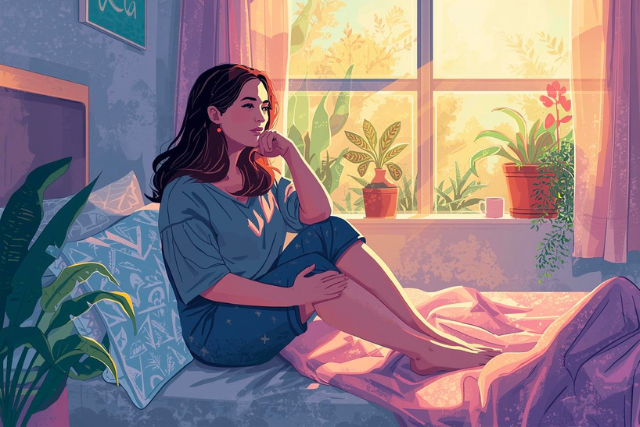
Sitting on my bed, staring at the ceiling in complete silence – not thinking about the to-do list for once – felt like a revelation. Choosing yourself doesn’t have to be loud or selfish. It’s a calm, steady realization that your peace is as non-negotiable as everyone else’s.
Slowly, the patterns that once ruled me began to loosen. Emotional eating softened. The irritation faded. Anger loses its edge. I began to experience joy without waiting for the other shoe to drop. I can look at my children and feel presence instead of panic. Gratitude instead of fear. Love instead of constant vigilance.
I am still a work in progress.
And for the first time in my life, I’m deeply okay with that.
If you are a first born child who has learned to be small…
If you are someone who works twice as hard to keep…
If you’ve never been identified as a struggler because you’ve internalized everything…
If you learn to be invisible to keep the peace…
If a parent magnifies every old wound, you haven’t had time to heal…
Listen to this: you are not broken. You were brilliant to be alive. But survival and survival are not the same thing.
You are allowed to have the need. You are allowed to take place. You are allowed to rest without earning it. You are allowed to say no without explaining yourself. You are allowed to care, not just depend.
You don’t have to choose yourself out loud. You just have to choose yourself consistently. even gently. Even imperfectly. Even a small border at a time. You don’t disappear all at once. And you will not come back to yourself at once. You return to pieces. in breath In honest words. In moments where you stop and ask: What do I need now?
And then – slowly – you begin to answer yourself.

about Erin Vandermore
Erin Vandermore is a licensed therapist, mother of two, and creator of MindCircuit™, a neuroscience-informed mental hygiene app. After years in survival mode, she now shares gentle tools for healing the nervous system. You can enjoy one of her 60-second “Brain Flossing™” calm resets created through her APP Mind Circuits for moments when you need more relaxation than your body suggests. Launch @mindcircuitapp Instagram And Facebook.