
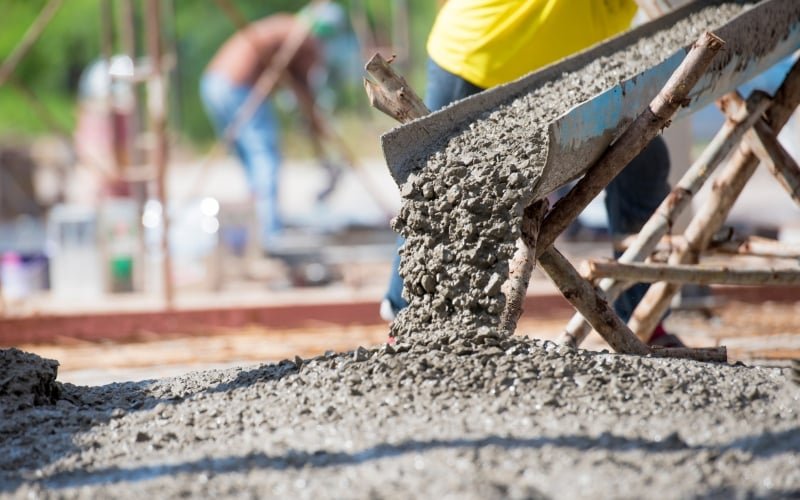

Concrete is all around you – in the foundations of your home, the bridges you pass, sidewalks and buildings in cities it is is often described as D Second most used material By volume on Earth after water.
But the way concrete is made today is also a major contributor to climate change.
Portland cement, the main component of concrete, accounts for approx 8% of global greenhouse gas emissions. That’s because it’s made by heating limestone to high temperatures, a process that burns large amounts of fossil fuels for energy and releases carbon dioxide from the limestone in the process.
The good news is that there are alternatives, and they’re gaining attention.
Portland cement: a greenhouse gas problem
Materials such as cement have been used in construction for thousands of years. Architects have found evidence of their use Pyramids of Egypt and buildings and aqueducts Roman Empire.
Portland cement commonly used in construction was patented in 1824 Joseph Aspdin, a British bricklayer.
The preparation of modern cement begins with pulverizing the excavated raw materials limestone and clay and then heating it. in a furnace A About 2,650 degrees Fahrenheit (about 1,450 °C) to form clinkerA hard, rock-like residue. The clinker is then cooled and mixed with gypsum into a fine powder, called cement.
Cement production accounts for about 40% of carbon dioxide emissions come from burning fossil fuels To generate the high heat required to run the kiln. The rest comes as heat Converts limestone (calcium carbonate) to lime (calcium oxide), releasing carbon dioxide.
All in all, between Half ton and 1 ton Greenhouse gas emissions per ton of Portland cement. Cement is a binding agent that is mixed with water to hold it together to form concrete. it makes About 10% to 15% Concrete mix by weight.
Alternative technologies can reduce emissions
As population, cities and new infrastructure need to expand, The use of cement is increasingThis makes it important to find alternatives with lower environmental costs.
Some strategies to reduce carbon dioxide emissions include replacing some clinker – typically a solid residue made from limestone – with Supplementary materials such as clay, or fly ash and slag from industry. Reduction of cement quantity by other methods Waste sawdust is mixed or recycled Materials like plastic.
The long-term solution to reducing cement emissions, however, is to completely replace traditional cement with alternatives. An alternative is Geopolymer Made from earthen clay and industrial waste.
Geopolymers: A more climate-friendly solution
Geopolymers can be made by mixing materials such as clay rich in aluminum and silicon minerals with a chemical activator through a process. Geopolymerization. The activator transforms the silicon and aluminum into a structure that will look like cement. All this can happen at room temperature.
The main difference between cement and geopolymer is that cement is mainly made of calcium, whereas geopolymers are made of silicon and aluminum with some possible calcium in their composition.
These geopolymers have been found to possess High strength and durabilityCo-elasticity Freeze-thaw cycle and resistance heat and firewhich are important requirements in construction. Studies have shown that some geopolymers can provide Comparable if not better strength than traditional cement And, because they do not require heat like clinker, they can be produced with Significantly lower greenhouse gas emissions.
Geopolymers can also be produced from a variety of raw materials rich in aluminum and silicon, including clay clay, fly ash, Blast furnace slag, Rice bran ash, Iron ore waste And Recycled construction brick waste. Geopolymer technology can be adapted depending on the locally available clay or industrial waste in an area.
An additional advantage of geopolymers is that changes in the mix can produce different properties.
For example, Me and my co-researcher At the University of Aveiro in Portugal, waste from the cork industry—residues from making bottle corks—was added to clay-based geopolymers and found that it could Improve the strength of the material up to twice. Cork particles fill the voids in the geopolymer structure, making it denser, which increases strength.
Likewise, additives such as Sisal fiber from the agave plant, Recycled plastic And steel fiber can change geopolymer properties. Additives do not participate in the geopolymerization process but act as fillers in the structure.
Geopolymer structures can also be designed to act as adsorbents, Attracts toxic metals to wastewater And Capture and storage of radioactive waste. Specifically, to include Materials such as zeolites which are natural adsorbents in geopolymer structures may also make them suitable for such applications.
Where geopolymers are now used
Geopolymer has been used Many types of constructionincluding roads, coatings, 3D printing, coastal environmental protection, steel and chemical industries, sewage rehabilitation and radiation protection buildings and rocket launchpads and bunker infrastructure.
One of the earliest examples of a modern geopolymer concrete project is Brisbane West Wellcamp Airport in Australia.
It was built in 2014 70,000 metric tons of geopolymer concretewhich was estimated to reduce the project’s carbon dioxide emissions as much as 80%.
The geopolymer market is currently estimated at US$7 billion And $10 billionwith The largest growth was in the Asia-Pacific region.
Analysts have speculated that market rates may rise 10% from 20% per year and reach approx $62 billion by 2033.
In several countries, Greenhouse gas regulations and green-building certification It is expected to support the continued growth of geopolymers in the construction industry.
Expanding use of cement substitutes
The advantage of using industrial waste in geopolymers is a double-edged sword. The composition of industrial waste varies, so it can be difficult to standardize processing methods. Geopolymer components need to be mixed in specific proportions to achieve desired properties.
Manufacturing activators for geopolymers, which is typically done in chemical facilities, can increase costs and contribute to the carbon footprint. And long-term data on the stability of these materials are now being generated based on their novelty. Also, these geopolymers can Takes longer to set up Compared to cement, however, setting time can be increased by using faster-reacting raw materials.
Developing inexpensive, naturally available activators Agricultural waste rice bran Sustainable supply chains can help reduce costs and environmental impact. Also, printing the recipe on the raw material packaging can help simplify the task of determining mix proportions so that geopolymers can be used more widely with confidence.
Although geopolymer technology has some drawbacks, these low-carbon alternatives have great potential to reduce emissions from the construction sector.
Alsina Johnson MerchantResearch Scientist in Chemistry, Washington University in St. Louis
Reprinted from this article the conversation Under Creative Commons license. read on Main article.



