
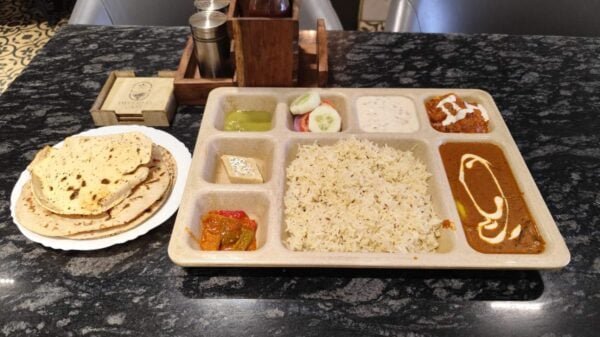


My favorite Indian dish is Chicken Tikka Masala. Back in the day, in Jackson Heights Queens, I would go to an Indian buffet restaurant called Jackson Diner at least once a week for a meal of chicken tikka masala, chickpeas, vegetables and naan (thin bread). If I ever become a condemned prisoner, this will be my last meal request. So I joked with my friends that I was going to eat chicken tikka masala every day of my 22 day trip to India (it would be only $5 a plate there) and probably come back with an extra 15kg. Instead, I became a vegetarian and lost a few kilos.
The first restaurant I went to was an all-vegetarian place. I desperately scoured the Chicken Tikka Masala menu until I realized it was an all-vegetarian menu. There are many, many all-vegetarian restaurants in India for religious and cultural reasons. It was rude to get up and walk out, so I quickly opted for the mushroom masala and garlic naan. It was delicious and it filled me up. I realized, in fact, that the mushroom masala with naan is just as delicious as the chicken tikka masala. I almost couldn’t tell the difference. You put that spice on the mushrooms, scoop it up with the naan and it’s just as delicious.

 Then I learned about cheese – it’s a type of cheese from cow or buffalo milk (I thought it was a type of tofu at first). I learned it is also covered in spices and one can scoop it with naan and it is delicious too. Soon I was trying practically everything on the vegetarian menu and was rejoicing in the fact that I was no longer eating meat. Like many of us, I sympathize with vegetarians and vegans but being surrounded by meat always lacked the resolve to make big changes. Also, I never bothered to sit down and figure out how I would create a vegan lifestyle – what foods to buy, how to cook them, etc. And then it hit me.
One of the reasons I didn’t go vegan had nothing to do with taste or my willpower. Like many problems in our society, it is structural. American restaurants and supermarkets make vegetarianism difficult. I understand that most supermarkets, for example, could easily create a “vegetarian corner” where it would be easy to grab non-meat protein sources and some inexpensive brochures on how to cook cheese, peas, beans, tofu, etc. They may have some masala or sauce and lots of naan or other types of bread, lentils. They could make it easier.
People can learn how to eat differently, but they don’t get the opportunity from their supermarket. Instead, they prefer the simplest and most traditional foods that also end up being the least healthy. We’re getting fat not because we lack discipline, but because our food system encourages our culinary laziness, forces meat on us because it’s more profitable and punishes curiosity and experimentation. It took a trip to India, where vegetarian restaurants are ubiquitous, for me to realize that if there were opportunities for non-vegetarian options, I would happily take them.
The US food system makes vegetarianism difficult because corporations have no incentive to facilitate it. Perhaps the key is to encourage food suppliers to take advantage of vegetarian food.
Here are the economic facts: Processed meat products are more profitable. Fast, salty, greasy food keeps customers coming back. Supermarkets are designed for convenience, not health. Educating customers takes effort and likely won’t increase profits. So the default American diet is economically “engineered” and not rationally chosen. People don’t research what they don’t have and if the easiest option is a big fatty burger filled with grease and covered in cheese, people will just eat those burgers. If the easiest option is chana masala, people will eat chana masala. US adds research and work on vegetarianism while India removes it.
So what to do?
A starting point might be to reward stores that already make veganism easy (if you know). This is the simplest consumer-level pressure. Buy from supermarkets that already have a real vegetarian section. Support co-ops, ethnic grocers and small chains that stock plant-based staples. Even shift 20-30% of your grocery spending to places that make vegan eating easy.
Companies obsessively track spending patterns, and if enough people shift even a fraction of their purchases, stores will respond. This is how gluten-free, organic and plant-based milks have gone mainstream… with buying patterns that have become impossible to ignore.
Another trick – many American supermarkets have feedback or suggestion cards that you can fill out and drop in their suggestion box. You can suggest that they start a vegetarian corner. “Hi, I’m a regular customer who’s a vegetarian and I love your store. Would you please consider creating a small vegetarian-friendly section that combines plant-based proteins with sauces, seasonings and ready-to-cook items that people need to make quick vegetarian meals? I know a few others around here who would be excited about that.” If you can find your local supermarket’s email address, you can send them a friendly email to check.
Another trick is, basically, what I did in New Delhi – finding restaurants that serve vegetarian food and going to them exclusively. Chinese restaurants are one of the best vegetarian survival zones in American cities, but they’re not the only type of restaurant that will help you. The best vegetarian food in American cities comes from immigrant cuisine whose culinary traditions did not primarily center around meat.
Chinese places are generally good because the cuisine already has tofu as the default protein, greens, mushrooms, eggplant, whole meals built around noodles, and many Chinatowns have Buddhist vegetarian menus.
In the US, Indian restaurants are the closest thing I have to Delhi-style with dal, chana, rajma (high protein), veg thalis (the built-in variety), paneer dishes (protein without meat). It is the most reliable vegetarian infrastructure in American cities. Middle Eastern/Mediterranean restaurants have falafel, hummus, baba ghanush, lentil soup, muzadara. These recipes treat legumes as normal foods, not as “options”. By the way, have you ever eaten Ethiopian food? Or, how about Mexican? Beans, rice, veggie tacos, salsas, nopales. Beans are packed with protein.
But who wants to do the research? I don’t know how to cook this stuff. Where can I get my protein?
OK, so no one wants to do research, but research is no longer problematic. You probably use AI for a variety of reasons. Type in a simple prompt: “Give me three vegetarian meals I can make this week that require zero cooking skills and use ingredients from a typical American supermarket. Make sure I get enough protein and I don’t want fat.”
I did just that. Here is what my AI gave me:
Greek Yogurt Power Bowl
Protein: ~25-30 grams
How:
1 large tub 0% Greek yogurt
Handful of berries
1-2 tablespoons of nuts (almonds or walnuts)
Optional: Drizzle honey if you need it sweeter
Why it works: Greek yogurt is basically a protein bomb with almost no fat if you buy 0%.
Microwave Lentil + Veg Bowl
Protein: ~20-25 grams
How:
1 pouch microwaveable lentils (Trader Joe’s, Whole Foods, Target, etc.)
1 bag frozen mixed vegetables
2 tablespoons salsa or bottled vinaigrette
Why it works: Lentils give you protein + fiber, veggies keep calories low, and the whole thing is only microwaveable.
Tofu + stir-fry sauce + frozen veg
Protein: 20 grams
How:
1 block firm tofu (no cooking: just cube it)
1 bag frozen stir-fried vegetables (microwave)
2-3 tbsp bottled stir-fry sauce
Why it works: Tofu is lean protein; The sauce gives flavor; Frozen vegetables keep volume high without fat.
Here’s another prompt: Give me a week of vegetarian meals that require zero cooking skills, use only typical American supermarket ingredients, at least 20-30 grams of protein per meal, be low in fat, and avoid anything that might make me gain weight.
So, you need no textbooks, no nutrition charts, no hours on YouTube. Sort the prompt as you want (no cooking, minimal cooking, extra cooking) and get a week’s worth of meals, a shopping list and protein sources. Eliminate inconvenience and annoying things and vegetarians are possible.
Here’s something that struck me in India: Why do we eat? At the most basic level, I eat because if I don’t, I feel hunger pangs and the longer I wait, the worse they get. Hunger is a signal that is loud. You don’t need meat to silence this signal. We eat far more meat than we need, and it’s bad for the environment, bad for animals, and not good for our health.
The point is that you can stave off hunger pangs with cheap vegetarian food. If you can satisfy that hunger with a bowl of mushroom masala or a plate of Chinese stir-fried vegetables, or yogurt, tofu, rice, lentils – that’s the way to go. You can satisfy hunger with fatty junk that makes you worse, or you can satisfy it with foods that actually support your body.
Since I stopped eating meat on this trip, I feel better. I’m lighter, cleaner and I’m finally trimming down again. I’m not preaching, I’m just describing what happened to me. I am happy to eat this way and I wish the same for you.
Photo courtesy of author