
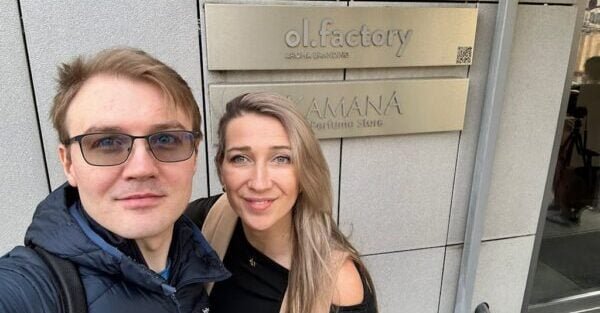


Christina Kurhanska is a Ukrainian entrepreneur, aromatherapist and mental-health advocate based in Kyiv. He is the Chair of the Board and Public Head of the NGO Doladoo, registered in November 2022 to support the mental health, rehabilitation and reintegration of Ukrainian defenders, veterans and the wider public. Public speaker Bios said Doladu operated a mental-health center at a Kyiv hospital and served more than 1,650 people, while later public interviews said it supported more than 1,800 service members. Kurhanska also founded the fragrance-branding agency Ol.factory and the Kamana perfume store, combining business, sensory design, psychology and experience-focused social recovery work.
In this interview, Scott Douglas Jacobsen Kristina Kurhanska, a Ukrainian entrepreneur, aromatherapist and mental-health advocate, talks about fragrance marketing as an emotional and behavioral tool. Kurhanska explains how fragrance complements visual and verbal branding by forming atmospheres, memories and beliefs, particularly through the close relationship of scent with emotion and memory processing. He discusses how fragrance techniques differ across medical, retail and cultural settings, and outlines his European-Ukrainian production model, including fragrance development in Grasse and implementation in Ukraine. The conversation also explores sustainability, ingredient control, market specialization and how emotional design can support both branding and psychological well-being.
Scott Douglas Jacobsen: How would you define fragrance marketing? Usually, when we think of marketing, we think of text, visual media or audiovisual media. How does scent work along those channels? And when people come to an event or encounter a brand, how do you use scent as part of that experience?
Christina Kurhanska: People make many decisions emotionally, even when they believe they are acting purely rationally. In my work, scent is a tool that can shape emotional states and behavioral responses. In the DoLadu material, I describe this as part of a larger ecosystem: fragrance can influence emotions, memories, and behavior through connections with the limbic system. It does not replace other channels, but it can complement them by creating atmosphere, association and emotional identity.
Jacobsen: So is emotion driving the process?
Kurhanska: yes One of the fastest ways to influence a person’s mental state is through scent.
Jacobsen: Culturally, when advertising or marketing in Ukraine, especially in a big city like Kyiv, what kind of scent do people respond to?
Kurhanska: It depends on the purpose and context. Fragrance marketing is not about a universal choice. It’s about creating a specific environment that supports a desired emotional response.
For example, in medical settings, scents are often used for relaxation. If a person feels calm, they are more likely to feel safe, cared for and confident in the professionals around them. This improves the overall experience for the individual and can support trust in the organization.
In general, scent works on an emotional level that people don’t always consciously recognize. A person may later recommend a place or product and simply say, “That felt good” without identifying why. Scent is one factor that can shape that impression.
There is research suggesting that environmental factors, including smell, can influence perception and behavior, such as how people evaluate products or places. However, it is important to be careful not to overstate the effect. Fragrance is an element within a broad sensory and psychological environment.
Jacobsen: I was traveling to Israel and Jordan last year. In places like Amman, perfume shops often mix scents and diffuse them into the air to shape the atmosphere. In Ukraine, what is a common or appropriate way to use scent in marketing?
Kurhanska: It totally depends on the goal.
In retail, for example, approaches vary by product type and price point. For high-value items, such as jewelry, the goal is often to create an environment where a person feels comfortable taking time to make a decision. This may involve a quieter, more refined scent profile.
In mass-market retail, where decisions are made quickly, the approach can support a faster, more energetic environment. So the strategy changes depending on target reflexes or speed.
For cultural projects, scent can serve as a nonverbal language. It helps create emotional context and atmosphere without relying on words. It works alongside the visual and auditory components rather than replacing them.
Jacobsen: If a picture is worth a thousand words, how many words is a scent worth?
Kurhanska: In a sense, all of them—because it works directly on emotion rather than language.
Jacobsen: What do you find in terms of effective partnerships with European suppliers of high-end fragrance products? How do you build those relationships?
Kurhanska: We develop most of our fragrances in Grasse, which is considered a global center of fragrance. The region has long-standing expertise, access to raw materials and established manufacturing standards.
We work with professional perfumers – often referred to as “noses”. My role is to translate the client’s goals into a clear technical brief for the perfumer. This includes defining the desired scent profile, structure and composition – often referred to as the fragrance pyramid, with top, middle and base notes.
Because of my training, I can communicate with perfumers in a shared professional language. We collaborate with them in Grasse to manufacture the fragrance and then we import the finished product. The ultimate applications – how scent is used in spaces or products – are developed in Ukraine.
So, in reality, it is a European-Ukrainian partnership: formulation in France, implementation in Ukraine.
Jacobsen: That makes sense. A few years ago, I worked in ethical and sustainable fashion journalism. A recurring problem was sourcing, production and distribution. For example, synthetic fibers create long-term waste problems, while natural fibers can be part of a more circular system.
How does that lifecycle look at perfume — from sourcing to manufacturing, distribution and sustainability considerations?
Jacobsen: So how does that lifecycle work in practice? Would you say that it is a very competitive market here?
Kurhanska: It depends on the business model and product type.
In perfumery, fragrances are created through controlled processes using both natural and synthetic ingredients. The balance between them depends on quality, cost, safety standards and regulation. For example, aerosol-based fragrance systems use formulated compounds designed for consistency and stability, while fine fragrances or high-end applications may incorporate synthetics as well as more natural ingredients.
We work with high-quality materials that meet international certification standards. If the goal is to influence emotional perception or create a more subtle sensory experience, the composition and quality of the ingredients becomes particularly important. However, it is not correct to say that only natural ingredients are effective – modern fragrances rely on a combination of natural and synthetic ingredients.
There are also regulatory limitations. For example, some traditional animal-derived ingredients such as natural musk or ambergris are restricted or banned, so perfumers use safe and legal synthetic alternatives instead.
Ultimately, the formulation depends on the brand’s objectives, location and budget. It is possible to create perfumes at a lower cost, or to create more complex and refined compositions that feel more individual to the user.
For markets, the war-time situation in Ukraine is challenging. Compared to before 2022, demand in our segment has decreased significantly. But our work is quite specialized. We are one of the few firms that offer a full-spectrum approach from concept and formulation to implementation.
We develop olfactory strategies based on a client’s intrinsic goals. We create private-label products, integrating fragrance with branding and packaging. This may include diffusers, sprays, car fragrances, or scent systems integrated into spaces through ventilation or dedicated equipment.
There are competitors in Ukraine who focus on specific segments, such as product manufacturing or fragrance services for the space. Our approach is to work across all these levels and build long-term relationships with clients who value a comprehensive emotional strategy.
Jacobsen: Thank you so much for the opportunity and your time, Khrystyna.
–
Scott Douglas Jacobsen A writer-editor for Good Men Project With over 1,800 publications on the platform. He is its founder and publisher In-Site Publishing (ISBN: 978-1-0692343; 978-1-0673505) and its editor-in-chief In-Site: Interview (ISSN: 2369-6885). He writes for International Policy Digest (ISSN: 2332-9416), humanist (Print: ISSN, 0018-7399; Online: ISSN, 2163-3576), Basic Income Earth Network (UK registered charity 1177066), Humanist perspective (ISSN: 1719-6337), A further investigation (substack), vocal, moderate, New lighting project, Washington Outsider, rabble.caand other media. His bibliography can be found through the index Jacobsen Bank In-Site Publishing has more than 10,000 articles, interviews and republications in more than 200 outlets. He has held national and international leadership roles within humanitarian and media organizations, held several academic fellowships, and currently serves on several boards. He is a member in good standing of numerous media organizations including Canadian Journalists Association, Penn Canada (CRA: 88916 2541 RR0001), and Reporters Without Borders (SIREN: 343 684 221/SIRET: 343 684 221 00041/EIN: 20-0708028), and others.
***


If you believe in the work we’re doing here at The Good Men Project and want a deeper connection with our community, join us as a Premium Member today.
Premium members can watch The Good Men Project without any ads. Need more information? A full list of benefits is here.
–
Photo by Scott Douglas Jacobsen.