


nomenclature
Meaning of L LoricariidaeThe saucermouth armored catfish family is found in South America, including the Amazon. 046 indicates that when they entered the trade, they were the 46th undescribed loricarid catfish recognized by DATZ.
I first saw L046 while working at the Zoological Museum in Amsterdam in the form of 8 and 10 alcohol-preserved specimens in two jars numbered ZMA120.655 and ZMA 120.457. When my colleagues Isaac Isbrücker and Han Nijssen, two leading experts on Loricariidae, described the taxonomy of catfish in 1991, they sent no fewer than 224 specimens of this unnamed species:
“It was collected by the staff of Tropicarium Para for commercial (aquarium) purposes … The aim of this note is to give this conspicuous species (referred to in the aquarium trade as “zebra pleco” …) a scientific name … to withdraw it from its current nomenclatural anonymity.
They were so different from other catfish that Isbrucker and Nijsen not only gave them their own species name (“zebra”) but even created a new genus for it — Hypansistrus. (ancistrus Another species of catfish, equally common in the aquarium trade, and hypo means less, refers to this fact. Hypancistrus zebra had fewer teeth than ancistrus and no filiform teeth.).
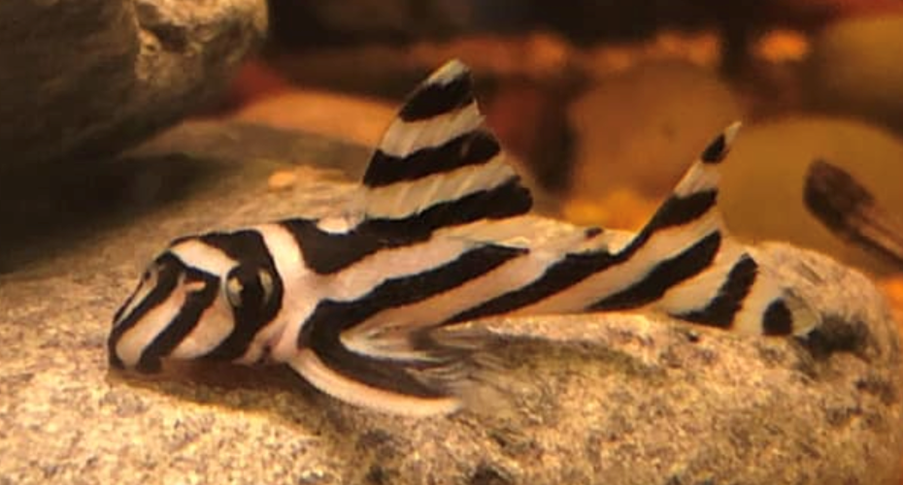
Hypancistrus zebraThe Zebra Pleco, still referred to as L046, is indeed conspicuous and quite fascinating. They are rather small fish, white all over, with horizontal black stripes on their bodies. It’s no wonder aquarium enthusiasts love them.
Protected but still business
Native to the Xingu River in northern Brazil, this fascinating little fish first entered international trade in 1988, three years before scientific description. Brazilian authorities quickly recognized the need for regulation and banned exports in 2004. It secures them in their home country.
A few additional steps were taken to enhance that protection outside of Brazil. International trade in wildlife is regulated through the Convention on International Trade in Endangered Species of Wild Fauna and Flora (CITES). In 2017 Brazil unilaterally added the zebra pleco to CITES Appendix III, which regulates international trade and requires an export permit or certificate of origin. In 2022 Brazil proposed to include the zebra pleco in CITES Appendix I, which would have banned all but commercial trade in the species, but this was not accepted by signatories to the agreement. A compromise was reached and the species was placed in Appendix II, requiring all commercial export permits. Given its protected status in Brazil, no trade is allowed in wild-caught individuals.
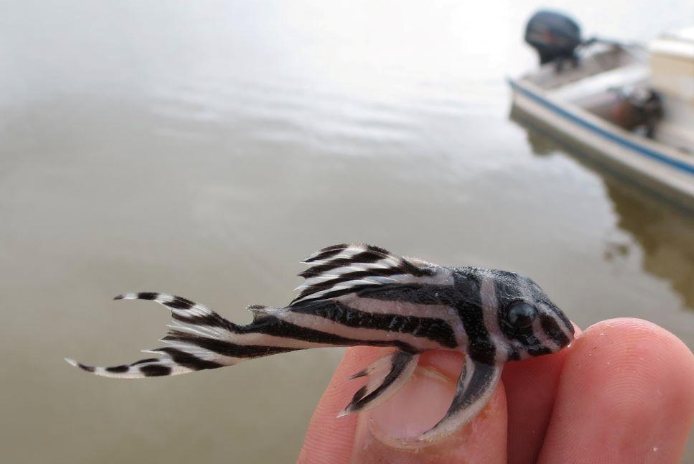
It hasn’t stopped trading, though – far from it. Zebra Pleco is still sold in the thousands each year.
Today the largest legal exporter of zebra pleco is not Brazil but Indonesia, where they are widely bred. Stocks established for Indonesian exporters before the 2004 export ban may have been individuals legally imported from Brazil, but evidence suggests that these were almost certainly augmented by wild zebra plecos obtained later.
Since 2017, Indonesia has reported exports of around 30,000 zebra pleco, all captive-bred. The most significant importers are the United States (about 22,000 individuals) and the European Union and the United Kingdom (about 16,000 individuals).
But work by Brazilian researchers shows that this is far from a complete picture. Based on interviews with traders, they estimate that around 100,000 zebra pleco are still taken from Brazil each year. Mortality rates are high, and about half or more of the animals die during transport, but 70% of them are exported to China, often illegally transiting through Colombia and Peru.
Although it is almost certain that a good proportion of the international trade in captive-bred zebra plecos is not reported, this suggests that the trade in wild-caught specimens is at least as large as the legal trade in captive-bred ones.
Thanks to the attention and protection of Brazilian authorities, aquarium enthusiasts, and conservationists in Brazil — and the foresight to include the species in CITES Appendix III (and later II) — we have good insight into the legal international trade of zebra plecos. Research devoted to illegal trade complements this picture. It also helps that the breed was given a name years after it entered the trade.
But many other species did not enjoy the same benefits.
the great unknown
L046 was the 46th unspecified armored Catfish at DATZ. It was in 1988. We are now at L600. These include duplicates and species that have subsequently been given a scientific name. I estimate that there are about 380 armored catfish species that are not yet scientifically named but are traded internationally. They have common names such as Paru Tiger Pleco (L494), Freckled Tiger Pleco (L493), Jatupu Toad Pleco (L431), and Elegant Zebra Pleco (L399).
For some we know which genus they belong to, but for others we only know it at the family level (eg, Cotton-spotted Pleco, L068). Many of these elusive but internationally traded catfish have very small geographic ranges. We have virtually no data on how sustainable this trade is, and all of these species could benefit from better regulation of their international trade.
A rose by any other name…
We aquarium enthusiasts are strange people — we obviously love our fish, we take good care of them, we study them, we observe them, and we show them off to our friends and family.
But for some species, we love them to death. I’ve often compared the exotic aquarium fish hobby to the market for cut flowers — roses, tulips and the like. When we buy our fish, like cut flowers, they are fresh and colorful and we try to keep them that way. And we do – for a few months, a year, even a few years. But then they die, and we make another trip to the aquarium store and buy new ones.
Agreed, some hobbyists breed some of their fish, as I do occasionally. But in normal community aquariums, where we keep different fish species in high density, breeding is not suitable. More fish die than are born and this keeps the aquarium business alive and profitable.
Like tulips and roses, many freshwater fish are commercially bred in large numbers, often in countries outside the species’ natural range (such as the zebra pleco in Indonesia). This part of the trade will have little negative impact on wild fish populations. But this is not true for all species, and there is a passionate group of freshwater aquarium enthusiasts who seek out wild-caught, novel, and new or yet-to-be-described species that often have very small geographic distributions.
For the armored catfish of South and Central America alone, it affects hundreds of species. But a similar system exists for another group of armored catfish, such as corys (CorridorsC-numbers 1 to 158), dwarf cichlids (EpistogrammaA-numbers 1 to 243), and in freshwater stingrays (PotamotrigonP-numbers 1 to 62).
In other groups — including killifish, but also several groups of snakes and lizards — hobbyists and traders refer to new forms by their collection sites rather than by numbered lists (e.g., biak, aru, kofiau, sorong form of green tree python). Morelia viridis) If we consider these other groups, we have thousands of species that are in trade but have completely flown under the radar in terms of monitoring the impact of this trade at the moment.
Solve this problem
How can we best control this trade in unnamed species?
Although CITES regulates international trade in most species that have a name (for example: tigers, Panthera tigris), there are also groups that are listed at higher taxonomic levels, such as genera (seahorses: Hippocampus spp.), family (hummingbirds: Trochilidae) or even order (Primates).
Should we do this with these nameless aquarium fish and other commercial species?
It is imperative that CITES as well as national wildlife protection and legislation move from passive compliance to active, data-driven management, with better levels of supply chain traceability.
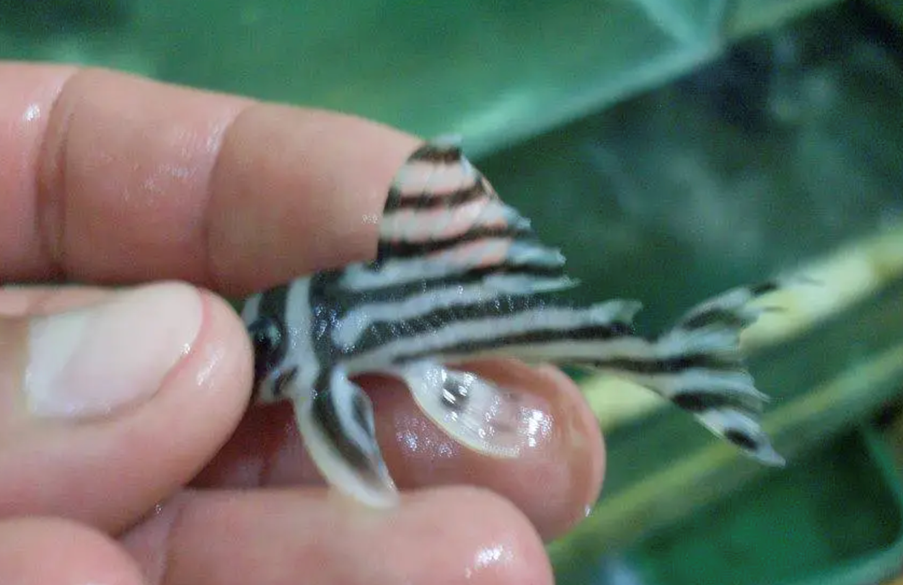
From a precautionary perspective, international trade should not lead to the extinction of a species, even if it remains to be named. It would therefore be prudent to consider listing some of these groups at this higher level in CITES Appendix II, or, more simply, Appendix III.
For example, L260 – since 1998 traded under the name Queen Arabesque Pleco – has not been scientifically described, but has been placed in the same genus as Zebra Pleco (eg, Hypansistrus) like the zebra pleco, it is confined to a small Brazilian river system, the Rio Tapajós, and faces similar threats (primarily overharvesting and limited protection of its habitat). Inclusion of all species Hypansistrus International trade would be permitted in Appendix II or III of CITES. This would include the queen Arabesque pleco, although not scientifically named.
Without this basic level of protection, many of these species may disappear before science can even identify and name them.
L046 have avoided that fate — they are too popular to disappear entirely, even though they remain critically endangered in the wild and face an uncertain future in their native waters — but for many other unnamed species, continued existence is at best uncertain.
reference
de Sousa LM, Lucanus O, Arroyo-Mora JP, Kalacska M 2021. Conservation and trade in endangered species. Hypancistrus zebra (Siluriformes, Loricariidae), one of the most trafficked Brazilian fishes. Global Ecology and Conservation 27, 01570.
Isbrücker IJ, Nijssen H 1991. Hypancistrus zebraA new genus and species of uniquely pigmented ancistrin loricarid fish. Freshwater Ichthyological Exploration 1(4), 345-350.
Phelps J, Webb EL, Bickford D, Nijman V, Sodhi NS 2010. Boosting CITES. science 330(6012), 1752-1753.

All premium members can watch The Good Men Project without any ads.