

by Amalia Wampa
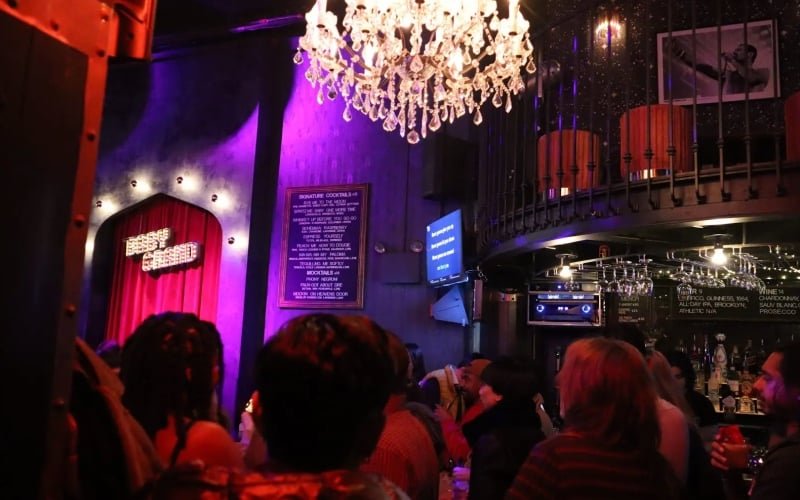
Singles explore the Thursday Events Singles Night at Baby Grand LES, November 13, 2025. (Credit: Amalia Wampa)
Generation Z is getting tired of superficial swipes on traditional dating apps. Many young adults are instead trying new singles apps that create personalized experiences to meet potential matches.
Sometimes referred to as “digital natives,” 91% of Tinder’s male and 94% of female users agree that dating has become more difficult, according to a 2024 Tinder study. Whether or not this is due to the popularity of dating apps is debated, according to a 2025 Loyola University study 45% of Gen Z users experience depression and frustration when using dating apps.
“I still think the best way to meet someone is through mutual friends or work,” says Nikolay Sudarikov, a single millennial in New York City. “Online dating would be my second option,” she said.
Unlike Sudarikov, many Gen Z singles never dated in a world where apps like Tinder or Hinge, which let users make quick choices based mostly on photos, never existed. For some, online dating has felt like it’s moved from a fun option to the only option.
Searching for connections, Sudarikov chooses to use new platforms, such as Thursday events, which lead him to private parties where he can meet different people. In a culture that has grown accustomed to connecting with others virtually, finding love offline holds more value and has become a more intentional approach.
Thursday Events and CitySun, another new entrant in the field, allow singles to sign up for various parties in their area by seeing who isn’t showing up. Users choose an age group, theme and location, for example an ugly-sweater party in Alphabet City or a dinner at Tommy Bahama restaurant in Midtown. Venues can range from local bars and arcades to a ski trip to France.
Thursday Events, based in London, was originally a dating app accessible only on Thursdays to encourage spontaneous plan-making.
George Rawlings and Matthew McNeil Love, launched the company in 2021 as ‘Thursday’. The app has amassed over two million users over its lifetime and boasts 29 babies as a result of their app connection. In early 2025, the company responded to the declining popularity of traditional dating apps by shifting its focus entirely to event planning. Now rebranded as the Thursday event, it hosts solo parties in nearly 150 cities around the world.
Meanwhile, Amata, an AI matchmaking app, was released in September 2025 in New York City.
Amtar has a similar model for Thursday events. The location, time and theme are all determined by a virtual AI matchmaker, except now, a user meets them on a date for the first time. The project raised $6 million before testing, founder Ludovic Huraux said.
Meanwhile, CitySun, based in Sydney, Australia and released in 2014, is active in more than 30 major cities around the world. Citysun has gained traction in the US and New York.
While companies like Thursday Events, CitySun and Amata aren’t close to taking on dating app giants like Hinge or Tinder, their efforts are indicative of the desire of the younger generation.
Dating apps, though initially revolutionary for busy professionals or single parents, have waned in popularity. A 2024 study published in Researchgate analyzed the effects of dating app use among young participants over 12 weeks and found that emotional exhaustion increased over time. 38.1% of participants even experienced symptoms consistent with clinical depression.
Anna Morgenster, who has worked as a matchmaker and dating coach in New York City for eight years, says the new apps are benefiting from several changes in behavior and entertainment.
“I think Gen Z is aspiring. They don’t have the example we’re giving them,” says Morgenster.
“Dating apps were like a novelty. It was fun. I don’t think the intended side effects were hiding behind their phones and not connecting easily in person.”
Morgenster, a millennial, said her generation’s dating life revolves around alcohol and meeting people at bars. Now, with only one in four young adults reporting frequent drinking, according to a long-term Gallup survey, they instead need other activities and locations to connect.
Statistically, millennials born between 1981 and 1996 and older Gen Z adults born between 1997 and 2000 make up the majority of Tinder’s consumer base. The full spectrum of Gen Z includes those born between 1997 and 2012, which make up 21% of Tinder’s consumer base, according to data from Resourcera, a market research site. Tinder’s revenue plateaued in 2024, with a 7% decline in paying users, according to internal data from its parent company, Match Group.
This downward slide on Tinder reflects a larger generational shift identified by Morgenstern. A 2025 survey by Himes found that Gen Z values meeting people naturally more than other age groups. While nearly a quarter say they found their partners through dating apps, many are overwhelmingly disaffected.
With changing attitudes around online dating, Tinder and Bumble have felt the hit and are looking for alternatives. Bumble laid off 30% of its workforce last June. Match Group followed suit, cutting 13% of its workforce and citing a decline in Gen Z users as a primary reason. In a letter to shareholders, Match Group said it will focus on this age group to boost profits. The company said that the number of paying users has continued to decline since 2023. Its stock fell 7% in October and is down nearly 80% from its peak in October 2021.
In response to declining demand, Bumble added filters for universities to help college students find others on campus more easily. Similarly, Tinder and Hinge have experimented with a double date feature where users and a friend can match up with two people instead of one to create a group experience.
Through these and other efforts, Tinder will continue to experiment with ways to draw in younger users, Cleo Long, the company’s senior director for global product marketing, told Business Insider.
“If we’re seeing it work for Gen Z, let’s give them more of what they’re asking for,” Long said.
Josh Mocklin, a 21-year-old Fordham University student, uses Hinge and apps like Raya, a dating app for public figures, creatives and celebrities, but said he’s become less intentional with them over time.
“I feel like every conversation I have with Raya or Hinge sparks and talks about having a drink soon, which rarely happens,” he said. Asked about single-event apps that prioritize personal interaction, he responded. “It looks like it could be fun.”
Thursday Events currently hosts single events in more than 150 cities across the United States, and in 2024, demand for the platform has grown enough to host international trips to Bali, the French Alps, and Croatia. Only Requirement: User must be single.
At a local Thursday night event in New York City on a November evening, a host scanned tickets and handed out bright pink wristbands to attendees. At Baby Grande on the Lower East Side, singles ages 21 to 35 mingle under dim lights as the night slowly builds. Some nervously sipped their drinks, while others who came with friends chose karaoke tracks to sing along to. Although the event started at 8 p.m., the room didn’t fully fill until 10 p.m., giving attendees time to settle in and start conversations.
Although Sudarikov didn’t feel the spark with anyone, it was a new experience that paved the way for good conversations.
–
Previously published with columbiannewsservice Creative Commons License
Photo Credit: Singles exploring the Thursday Events Singles Night at Baby Grand LES, November 13, 2025. (Credit: Amalia Wampa)
***
Join The Good Men Project as a Premium Member today.
All premium members can watch The Good Men Project without any ads. A full list of benefits is here.
–