
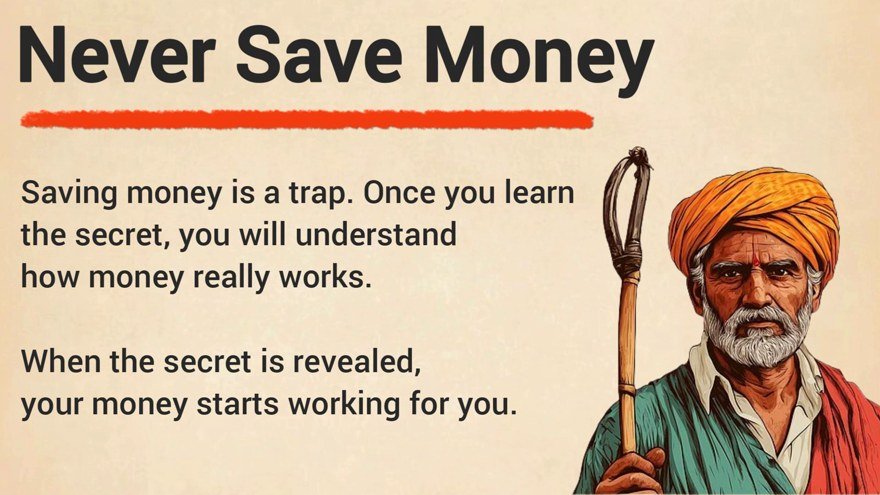

Welcome to our new lesson Learn English with motivation Series Never Save Money💰Have you ever been told that saving every penny is the only way to stay safe? Although discipline is important, many people fall into the “savings trap” where their hard-earned money loses value over time.
by today Graded Reader In the story, we follow the journey of a man named Silas. He goes from a dreamer to a hard worker, eventually discovering a “secret” that changes his family’s future forever. This story is designed to help you:
- Improve your English listening and reading In simple, clear language.
- Understand the difference Between stagnant savings and active growth.
- Find out why you “never save” But instead make your money work for you.
Let’s dive into the story of the “egg factory” and discover how to create a real future.
Don’t just save money, grow it
My grandfather always used to tell me: “Never just save your money.” This is the story of how he learned that lesson.
In a small village, there lived an old man named Silas. For a long time, people thought Silas was lazy. He sits under a tree all day, talking about big plans he never started. He dreamed of owning shops and cows, but he never worked to get them.
One night his grandson asked, “Grandpa, is there any bread?” The cupboard was empty. Silas realized that dreams could not fill a hungry stomach.
The next day, Silas finally went to work in the fields. The work was very difficult. The sun was hot, and his body ached. At the end of the week, he earns a little money. But money for food, medicine and repairs quickly disappeared.
Czar’s Secret
One day, Silas heard people say, “The secret of safety is to save.” He decided to try it. He found a large glass jar and hid it under his bed. Every week, he would drop a few coins inside. To him, the sound of coins sounded like hope.
To fill the jar, the family sacrifices a lot. Silas didn’t buy new shoes, even though his old ones were broken. They ate less food. His wife asked, “What’s the point of saving if we’re always hungry?” Silas simply replied, “One day you’ll understand.”
hard lesson
After a few months, the pot was full. Silas went to the market to buy three large bags of corn. But the seller shook his head. “The price has gone up,” the seller said. “This money can buy only one and a half bags now.”
Silas is shocked. He understood that Money loses its value If it just sits there over time. The coin pot was not large; It actually becomes less valuable.
a new beginning
Silas feels defeated until he sees his neighbors carrying eggs and milk. They weren’t just saving; They had things that produced daily food.
Silas bought some chickens with the last of his money. His grandson cheers, calling it their “egg factory.”
- First, they got two eggs a day.
- They ate one and sold the other.
- With the extra money they bought more chickens.
Soon, the yard was full of healthy birds. Neighbors came to Silas to buy fresh eggs. For the first time, Silas felt proud of his work.
the truth
One afternoon Silas held up an egg and said to his grandson, “It’s worth more than a jar of coins. This egg grows. It feeds us. It never loses its value.”
He realized his mistake. He said to all: “Saving money is like holding water in your hand—it always moves away. Instead, make your money work for you, even if you start small.”
That’s how Silas, the man who once dreamed, finally learns how to build a real future.
✅️ Inspirational life lessons from this story
The story of Silas and his “egg factory” offers a powerful shift in perspective on how we view time, effort, and resources. Here are key motivational lessons to take away:
1. Dreams without action are illusions
Silas spent years as an “idle man” as he waited for a “someday” that never came. He had great ideas, but they didn’t provide bread for his grandson.
- Lesson: A small, humble step today is worth more than a huge, perfect plan that you have in your head. Motivation is found in action, not just dreaming.
2. Conservation is not the same as building
Represents the glass jar under the bed Stagnant growth. Although Silas was proud of his discipline, he was actually losing “purchasing power” as the world went on while his money stood still.
- Lesson: Don’t just protect what you have; Find ways to make it productive. Whether it’s your money, your skills, or your time, don’t let them sit idle.
3. Wealth creates freedom
The turning point was when Silas stopped focusing on it currency (Currency) and start focus the chicken (wealth). Whether the price of corn rises or falls, the hen lays eggs.
- Lesson: Focus on building “engines”—things that produce value over and over again. It can be a side business, an education, or an investment that grows over time.
4. Start small, grow steadily
Silas did not buy an entire farm at once; He bought some thin chickens. He used the profit from one egg to eventually buy another chicken.
- Lesson: You don’t need luck to get started. You need enough to buy your “first chicken”. Success is often the result of small, compound wins that eventually fill the yard.
5. It’s never too late to change
Silas was known as the village idler for most of his life. He felt the sting of shame and the pain of hard work. Still, he was humble enough to listen to his grandson and change his tactics in his old age.
- Lesson: Your past identity does not have to be your future. You can learn “the greatest truth of your life” at any age, as long as you’re willing to look at the floor, admit what isn’t working, and try a new way.
Big Takeaway: Money is like water—if you hold it too tightly in a jar, it can lose its freshness or slip. But if you plant it like a seed (or a chicken), it will feed you for life.
✅️ Learn English from this story:
This story is an excellent tool for learning English because it uses clear imagery and blending The narrative is tomorrow. Here’s a breakdown of the key vocabulary and grammar concepts used in the story.
1. Key Vocabulary: “The Language of Growth”
Understanding these words will help you talk about work, money, and life changes.
- mercy (noun): Feeling sorry for someone else’s suffering.
- Example: “People looked at Silas with pity because he had no food.”
- Sacrifice (verb/noun): Giving up something important to get something else.
- Example: “They sacrificed an entire meal to save money on the jar.”
- value (noun): How much is something worth?
- Example: “Money lost value as the price of corn rose.”
- wealth (noun): Something you own that has value or produces more value (like chickens).
- immovable (adjective): Does not move or grow. (The money in the jar was immobile).
2. Grammar Focus: Contrast of Tense
The story goes on in between past simple (for completed action) and past continuous (for running background actions).
| tomorrow | Use in stories | example |
| past simple | To show a finished action. | “Silas bought A few chickens.” |
| past continuous | To show an action happening over time. | “He is was sitting While others worked under the trees.” |
| used to | To describe old habits changed. | “Silas used to be Lazy, but now he is hardworking.” |
3. Idioms and Expressions
The story uses metaphors to explain complex ideas. Here are three to keep in mind:
- “Life is not lived in dreams”: One cannot live by thinking alone; You must take action.
- “Keeping water in your hand”: Describes something that is very difficult to keep or save (eg money during inflation).
- “Make it work”: Using a resource so that it produces a result or profit.
4. Practice Exercise: “Chicken vs Jar”
To improve your English, try answering these questions using complete sentences:
- Why Silas failed money in the jar?(Target: Use the word “value” or “inflation”)
- How did the grandson’s life change at the end of the story?(Aim: Use Past Simple Tense)
- What is the difference between “saving” and “investing” in your own words?
5. Concept visualization
To understand the financial lessons that Silas learned, it helps to distinguish between Linear saving (container) and compound growth (chicken)
- jar (linear): You add 1 + 1 + 1. If you stop adding, it stops growing.
- Chicken (exponential): Resources produce a product (eggs), which you sell to buy more resources (chickens). Growth accelerates over time.
Frequently Asked Questions (FAQ)
1. What is the main lesson of Silas’ story? The key lesson is “saving money is like keeping water in your hand” as it often loses value over time due to rising prices. The story teaches that you should make your money work for you by investing in things that increase or produce value, just like Silas’ “egg factory.”
2. Why is saving money described as a “trap”? Saving is described as a trap because Silas worked very hard and sacrificed food and shoes to fill a jar with coins, only to find that he could no longer buy what he needed when prices rose. Fixed income does not increase; It remains constant while the world becomes more expensive.
3. What does “egg factory” mean? The egg factory represents a wealth. Instead of just keeping coins, Silas bought chickens that laid eggs every day. These eggs can be eaten or sold to buy more chickens, creating a cycle of growth that a jar of cash can’t provide.
4. Is this story suitable for English learners? Yes, this story is a Graded Reader Designed specifically for English acquisition. It uses:
- simple english To help readers understand complex financial concepts.
- a mixture past tense For grammar practice.
- Core Vocabulary choice value, wealthAnd Sacrifice To help you create a professional and inspiring dictionary.
5. How can I start applying this “Smart Mind” lesson today? As the story concludes, the best way to get started is to “work it up, even if you start small”. It means moving away from just dreaming or waiting for “someday” and taking a small, tangible step toward planting the “seed” of your own prosperity.
Conclusion
Silas’ biggest truth that we can all apply today: “Saving money is like holding water in your hand – it’s always moving. Make it work even if you start small”.
By shifting his focus from the coin jar to the yard full of chickens, Silas transformed his life from one of pity to one of prosperity. He realized that an asset that grows is always worth more than cash.
Final thoughts for your journey:
Don’t let your big plans remain as dreams in the shade of trees. Start your own “egg factory” today – whether it’s a new skill, a small business or an investment in your education.
Has this story changed the way you think about saving? Share your thoughts in the comments below! If you found this lesson helpful, be sure to explore our other ones English listening practice Stories keep your mind and your vocabulary growing.