


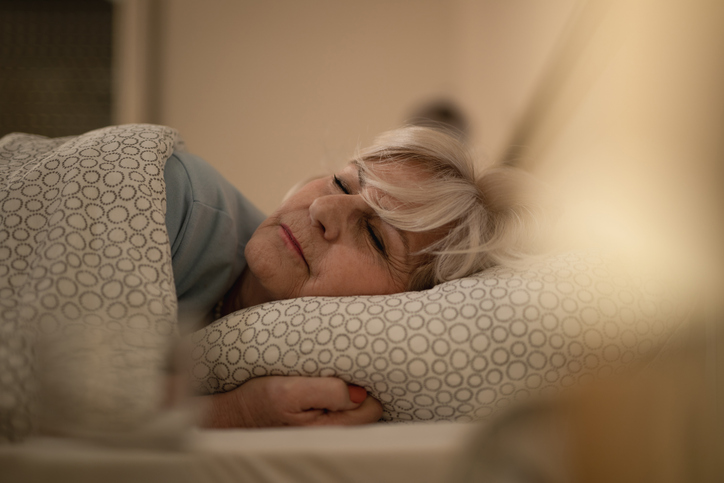
Being active is known to improve sleep, but research results are mixed about the best workout. Some studies say light walking or stretching is best, others favor moderate-intensity workouts like jogging—and some even find that vigorous exercise like swimming worsens sleep.
Addressing this discrepancy is important because good sleep is known to reduce the risk of dementia. An estimated 8 to 10 million older adults in the United States living with mild cognitive impairment — which sometimes precedes dementia — struggle to get a good night’s sleep. They sleep about 34 minutes less per night than others, take longer to fall asleep and spend more time awake throughout the night.
Now, researchers at the Texas A&M University School of Public Health’s Center for Community Health and Aging have a clear answer to the exercise question: Both light and vigorous exercise can reduce sleep disturbances in older adults with mild cognitive impairment.
“Most previous studies of sleep problems with this group relied on self-reported surveys, which can be problematic for participants with cognitive impairments,” said digital healthcare expert Jungju “Jay” Lee, who conducted the study with health behavior expert Junhyung “Paul” Kim. “We used more objective measurements.”
for their study in the journal Digital HealthLee and Kim used the Ora Ring to measure the effects of different intensities of physical activity on sleep disturbance in seven older adults with mild cognitive impairment at a long-term care facility in the United States.
For 14 days, Lee and Kim classified the wearers’ movement as light, moderate or vigorous based on metabolic equivalents and characterized restless sleep based on a specific combination of data on physical movement, heart rate spikes and changes in skin temperature. During that time, they met with participants twice per week for 15 to 20 minutes.
“We found that high-intensity exercise was the best way to improve sleep for these older adults,” Kim said. “For every additional second of vigorous activity, sleep disruption decreases by about one-fifth of a second.”
Light activity also reduced sleep problems, although the effect was much smaller and moderate exercise did not have a significant effect.
Despite several limitations of their study, including its small sample size and not breaking down participants’ physical activity patterns (such as cardiovascular or strength training), Lee and Kim believe their findings fill an important gap.
“The number of older adults with mild cognitive impairment in the United States alone is projected to increase by 76%—more than 21 million people—by 2060,” Kim said.
“Adaptive exercise programs such as group walking clubs or swimming lessons can be practical, fun and long-lasting ways for these older adults to prolong their quality of life.”
Source: Texas A&M University
–
This post was Previously published on FUTURITY.ORG and is republished here under a Creative Commons License.
–
A Good Men ProjectWe are happy to work from Syndicate the futureA publication dedicated to making research and science news accessible to the public We value Futures because it takes serious work from universities and researchers around the world and translates it into clear, readable stories that help understand what’s changing in science, health, technology, behavior and public life.
This is important to us for several reasons. We believe good information is part of how people live well in a rapidly changing world. Research can sometimes seem remote, technical, or intimidating, but it often speaks directly to questions that people are already living: how relationships work, how stress affects behavior, how health is shaped, how communities change, and how new discoveries can change everyday life in the years ahead. Future helps close that gap. It plays an important role in making evidence-based knowledge more accessible at a time when misinformation, cynicism and distrust of expertise can make it difficult for people to know what to believe. This is one of the reasons we are delighted to share this work with our readers.
Frequently Asked Questions – About the Good Men Project
What is the good male project?
The Good Men Project is a mission-driven media platform founded in 2010 that explores modern masculinity, men’s mental health, relationships, fatherhood, identity and social change through personal stories, expert insights and cultural analysis.
What is the mission of the Good Men Project?
Our mission is to expand the conversation about what it means to be a good person in the 21st century — in ways that are inclusive, emotionally honest, and grounded in real human experience.
How does GMP communicate content about science and technology?
We examine science and technology through their impact on people’s lives. From AI and automation to social media and climate science, GMP explores how rapid technological change affects identity, work, relationships, mental health, civic responsibility, and the legacy and civic responsibility we all inherit. We partner with other trusted sources, and trust science and research to inform good decisions in a rapidly changing world.
–


If you believe in the work we’re doing at The Good Men Project, please join us as a Premium Member today.
All premium members can watch The Good Men Project without any ads.
Need more information? A full list of benefits is here.
Good Men Project Founded in 2010, is a mission-driven media platform that helps authors, brands, agencies and organizations build credibility, audience and long-term authority. Publishing stories about masculinity, mental health, relationships, fatherhood, identity and personal development, GMP provides a trusted ecosystem where ideas gain visibility, trust and resilience in both search and AI-driven discovery. The platform supports individual contributors as well as high-volume agencies through paid guest posts, sponsored content, and a bulk publishing system designed for scale.
–
Photo credit: iStock.com



