
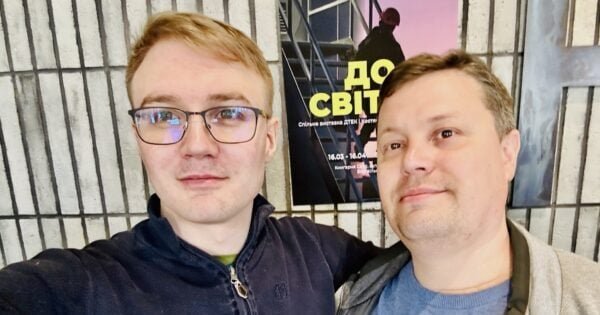


Kostiantyn Davydenko A Ukrainian public advocate and former prisoner who works to support civilians and prisoners affected by Russian internment. Inspired by personal experience, she helps document abuse, amplify prisoners’ stories, and support families awaiting news or release. Her work combines public service, legal and humanitarian awareness, and post-incarceration support. Davydenko emphasized resilience, compassion and civic duty, framing his efforts as a necessary service to Ukraine and those still suffering under siege.
Scott Douglas Jacobsen Kostiantyn Davydenko is interviewed by examining the cascading trauma, dehumanization, family uncertainty, difficulty of reunification, survivor’s guilt and perpetrators’ psychological rationalizations of Russian civilian internment in Ukraine. Davydenko explains how incarceration breaks up families, prolongs grief, and perpetuates emotional wounds long after release or confirmation of death. The conversation highlights the limits of rehabilitation, the persistence of trauma, and the wider social damage caused by detention practices adapted across occupied Ukrainian communities and their networks.
Scott Douglas Jacobsen: Civilians are affected immediately during capture and detention and, if they are lucky, upon release. There are also secondary effects on families—especially when a loved one is missing and their condition is unknown. Even after release, the consequences continue, putting pressure on family, extended social networks, friends and professional colleagues. What are some of the major pressures affecting this larger social ecosystem?
Kostiantyn Davydenko: Incarceration is a profound stress not only for the individual, but also for their families and loved ones. For prisoners, one of the central stresses is the experience of systemic dehumanization. This is not merely random or sporadic cruelty. While there are examples of arbitrary violence, most of it is structural—physical and psychological pressure designed to destroy a person’s sense of identity and autonomy and reduce them to someone who simply obeys orders.
For families, the pressures are different but equally severe. It is the loss of a loved one, often without clear information. Families know the person is suffering somewhere, but they don’t know where, in what condition, or even if they are still alive. This uncertainty can be overwhelming. People search for information, watch interviews with former prisoners and try to piece together what might have happened. Unfortunately, this often exacerbates their fears, as they project the worst possibilities onto their own situations.
This prolonged uncertainty is deeply painful. In many cases the family cannot bear the pressure and the relationship breaks down.
When a person returns from captivity, the situation is not simply resolved. The person who returns is often profoundly changed—psychologically and sometimes physically. At the same time, the family also suffers from chronic stress and trauma. As a result, reunification can be very difficult, and families can struggle to reconnect or understand each other.
There are particularly tragic cases of misidentification or delayed confirmation of death. In some situations, families believe their loved ones were incarcerated, only to later have DNA confirm that the person is dead and their remains identified. These moments are extremely painful. I know families who have experienced this and the emotional impact is devastating Some withdraw from contact altogether and their situation becomes very difficult. In such cases, how best to support them is often unclear.
Those undergoing treatment are entitled to it, but recovery is time-consuming. It is almost never possible to fully overcome such trauma, especially in cases of sexual violence or significant personal harm.
Unfortunately, Russian detention practices are highly adaptive, and the methods used can cause deep and lasting damage. Because of this, it is very difficult for people to completely overcome the consequences of what they have experienced. However, there are rehabilitation programs and voluntary initiatives—many internationally supported—that help ex-prisoners recover. With this support, many are able to regain some stability, even if full recovery remains challenging.
Jacobsen: What happens to civilians in situations where one family member is captured and the other is not? For example, one escapes while the other is captured or even killed. Are those who survive what is known as “survival crime”?
Davydenko: Yes, this is a common experience. Those who are incarcerated often feel shame, and those who are not incarcerated may also feel guilt—especially when a family member is captured or killed. They may question why they survived while others did not.
This is especially acute in cases involving children. When families lose a child, parents often struggle with overwhelming guilt, asking themselves why they survived and why their child didn’t. This is a very painful and common emotional reaction.
Jacobsen: Any insight into how Russian guards or officials view this? Do they express guilt or shame, or do they generally believe that they are justified, for example, that they are “liberating” the Ukrainians and that civilians deserve their treatment?
Davydenko: Based on information from ex-prisoners, there is usually little sign of remorse among those who commit these acts. Many believe they are doing the right thing. In some cases, they frame their actions as part of a larger mission—what they describe as “liberation.”
At the same time, there is a contradiction: while presenting themselves as liberators, they detain and mistreat civilians. It reflects a form of internal narrative shaped by state propaganda.
Such thinking appears to have strengthened within some of Russia’s state institutions, including the military and security services. Former detainees reported that guards sometimes justified their actions by portraying Ukrainians as enemies or as people who must be “reformed.” These justifications help justify their treatment of civilians.
Davydenko: We’ve seen many interviews where Russian operatives say, “I was following orders. I didn’t think I was doing anything wrong.” They explain that they were told the Ukrainians were fascists or dangerous enemies, and that their goal was to “liberate” the people. At the same time, violent actions were carried out on them.
This raises an important question for deep psychological study: how an ordinary person might come to justify such actions.
Jacobsen: Thank you very much for the opportunity and your time, Kostiantyn.
–
Scott Douglas Jacobsen A writer-editor for Good Men Project With over 1,800 publications on the platform. He is its founder and publisher In-Site Publishing (ISBN: 978-1-0692343; 978-1-0673505) and its editor-in-chief In-Site: Interview (ISSN: 2369-6885). He writes for International Policy Digest (ISSN: 2332-9416), humanist (Print: ISSN, 0018-7399; Online: ISSN, 2163-3576), Basic Income Earth Network (UK registered charity 1177066), Humanist perspective (ISSN: 1719-6337), A further investigation (substack), vocal, moderate, New lighting project, Washington Outsider, rabble.caand other media. His bibliography can be found through the index Jacobsen Bank In-Site Publishing has more than 10,000 articles, interviews and republications in more than 200 outlets. He has held national and international leadership roles within humanitarian and media organizations, held several academic fellowships, and currently serves on several boards. He is a member in good standing of numerous media organizations including Canadian Journalists Association, Penn Canada (CRA: 88916 2541 RR0001), and Reporters Without Borders (SIREN: 343 684 221/SIRET: 343 684 221 00041/EIN: 20-0708028), and others.
***


If you believe in the work we’re doing here at The Good Men Project and want a deeper connection with our community, join us as a Premium Member today.
Premium members can watch The Good Men Project without any ads. Need more information? A full list of benefits is here.
–
Photo by