


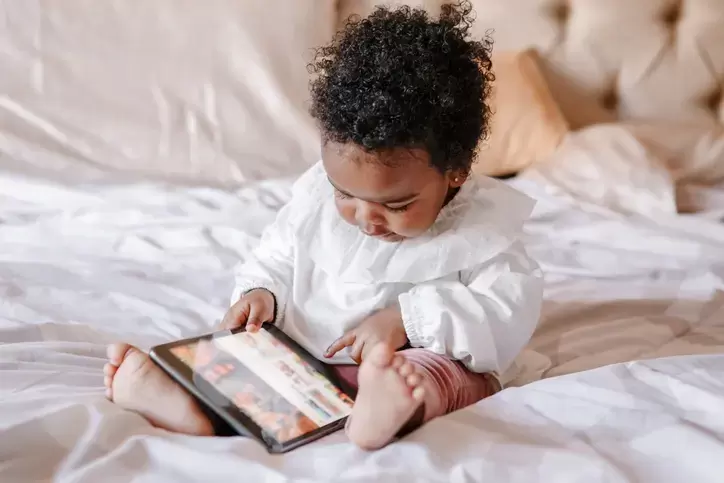

My baby and I hop together with the little bunny.
That’s our thing—sitting on the sidelines, watching Ms. Rachel, waving our hands, singing along. It’s one of my favorite parts of the day. There’s something about seeing a little person discover joy in real time that makes you feel, in short, that the world is just as safe and colorful as it appears on that screen.
It also takes me back.
For me, it was Miss Bobo, Big Boy and Mr. Bean.
I wasn’t young at all back then but I was young enough that the show felt like a whole world. I watched it with the same utter curiosity and delight my daughter brings to Mrs. Rachel. I wasn’t worried about money or food or shelter or what tomorrow would be like. All I wanted was to watch my show, Dexter’s Lab, Ben 10, and sneak outside to play with my friends when my parents weren’t looking — yes, I was a bit naughty.
During that season, life seemed really good. It wasn’t because everything was perfect, but because nothing had happened yet to prove otherwise.
When the beautiful world ends
My fantasy didn’t last long.
I had my first relationship at age 12, on Facebook, and it ended as quickly as it began. My first serious relationship started at 14 and lasted two years — breakups and reunions and the kind of crying that didn’t match the easy crying of childhood. I cried more over that relationship than I ever did watching Miss Bobo.
Then came university, my father retired, and I understood for the first time what it meant to break. To manage and navigate a life where financial footing was no longer certain. Miss Bobo became a memory and I spent years unable to remember the title of the show, searching online for images, trying to locate pieces of a world I had once fully inhabited.
I finally found it, after an incredibly difficult search.
And looking at it again, I felt something unexpected. A mild sense of betrayal—nOT in the show itself, but in the gap between what it showed me and what the world has become.
Mrs. Rachel doesn’t tell them what
Ms. Rachel is incredibly wonderful.
He taught my daughter to speak. My baby now sings, imitates gestures, lights up when the opening music starts. He may be more expressive, more verbal, more emotionally expressive without actually seeing a person with warmth and language while watching. Mrs. Rachel tells the children that their feelings are valid, that they can express emotions in a kind way, that the world around them is full of people who are happy to exist.
All this is good. All this matters.
And yet…
Not everyone will be as welcoming as Mr. Aaron.
Not everyone will laugh at them the way Miss Rachel does.
Ms. Rachel’s friends cheer for each other the way they wouldn’t cheer for them.
The world of that episode is happy (really, consistently, relentlessly happy) and that happiness fills my daughter’s mornings with something beautiful, It’s a world that doesn’t exist beyond the screen.
Mrs. Rachel teaches children that emotions should be processed with kindness and without physical harm. This is correct and important. It too, as a description of how people actually behave, is aspirational rather than descriptive. Prisons exist because a significant number of people never learned (or could sustain) the kind of emotional control these episodes model. The fear and pain in the world is often the direct result of unprocessed emotions acting out on other people.
My daughter may encounter those people. He may experience cruelty that has no explanation. He can find himself in rooms that don’t cheer for him, with people who don’t smile, navigating situations where the gentle tools he’s given collide with forces that don’t play by the same rules.
Maybe it’s okay, for now
I come back to this question: Does children’s television tell the truth about the children’s world?
And I keep arriving at the same uncertain answer: Maybe not yet.
I didn’t know the world was hard until it showed me.
And there’s an argument to be made that it shows you value the earlier years—that Miss Bobo’s childhood or Miss Rachel’s childhood are not as false as the completely protected, protected seasons. A window of true peace before complications arrive. Something to remember when the complications get heavy.
The social and emotional tools Miss Rachel gives children — the vocabulary of feelings, the habit of expressing them kindly, the experience of consistently celebrating just being — are not rendered useless when the world fails to match them. They are the baseline of carrying babies. His memory of what security felt like. Proof that kindness is possible, even when it’s not present.
My parents gave me a childhood that felt safe and warm enough that when things got tough, I had something to fall back on. That return is important. It still matters.
I am trying to do the same for my daughter. I cannot protect him from the hard side of the world—it will come, as it always does, in its own time and in ways I cannot fully predict or prevent. All I can do is give her childhood enough genuine warmth that she carries that warmth as a reference point for the rest of her life.
Part of Mrs. Rachel. The bunnies, the songs, Mr. Aaron’s easy smile, the consistent message that he is loved and that his feelings matter – it’s all going into the base.
I wish the world was growing
When I see my daughter watching Ms. Rachel, I find myself wanting.
The greetings of the world were actually like those episodes. Happy, then happy again. Kind of like a default. Colorful and safe and full of people who clap when you arrive. As parents we will be much relieved to know that the world our children are moving towards is what they practiced on screen.
We know it doesn’t. We know the gap is real and sometimes brutal.
So we do what parents have always done: we give them the best childhood possible, fill them with as much genuine warmth as we can provide, and trust that when the world finally shows its hard face, there will be something inside them that says: But I know it can be like that. I felt it. I remember
That memory is not a scam.
That memory is the whole point.
–
This post was Previously published at medium.com.
Love affair? We promise a better stay with your inbox.
Subscribe to get dating and relationship advice 3x weekly.
do you know We have 8 publications on Medium. Join us there!
***
–
Photo credit: iStock