
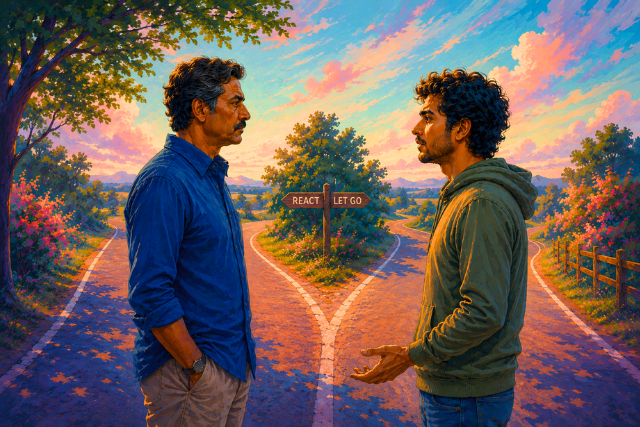


“There is a space between stimulus and response. In that space is our ability to choose our response.” ~Viktor E. Frankl
A few months ago, I was on a busy highway with my wife and son. Traffic was barely moving. The vehicles moved forward inch by inch, a small gap at a time, hanging in the air with the usual impatience.
Suddenly there was a loud sound. Something seemed to burst.
For a second, I didn’t understand what had happened. Then I realized that a motorcyclist trying to squeeze through the narrow space between the cars had hit us. His side bar tore into our back tire and he fell to the road.
We left immediately. We all shook. The motorcyclist was getting up, visibly startled.
My first reaction was anger.
We had already been stuck in that traffic jam for over an hour, and now had a damaged tire to deal with in the middle of it. The difficulty, the carelessness, the sudden interruption—all came together at that moment.
But something unexpected happened.
My son was driving, and I could feel the tension in him. The motorcyclist got up, apologized and offered to pay a small amount for the damage. It was clearly not enough, and under different circumstances, we could have argued.
I might have reacted very differently. Raised my voice, questioned his carelessness, and insisted on compensation right there on the road.
It can easily turn into an argument, attracting attention and adding to the chaos around us. And that would only add to that tension.
Instead, we focused on the immediate problem. It was not possible to change a tire in such traffic. The cars were packed very closely and there was no room to do it safely.
So we made a tough decision. We drove.
For about two kilometers, we drove carefully on a damaged tire, the car was unstable, its noise reminded us of what had just happened. Finally, we found a small street tire shop and replaced it.
The entire episode set us back nearly two hours.
There was still tension for a while. We were upset before the incident, and this only exacerbated it. But as soon as we got back on the road, something changed.
We found ourselves speaking normally again. We stopped for a delicious lunch and enjoyed the rest of the journey almost without noticing.
I later thought how easily that moment could have gone differently.
We could argue with the motorcyclist. We could hold onto our anger by replaying the incident in our minds. What happened would not have changed. Tires will still need to be replaced. There would still be delays.
But it would have changed the rest of the day.
Sometimes, not reacting is not being calm or being deliberately patient. It’s just about seeing clearly what the situation calls for.
At that point, what we needed was not an argument. This was a solution.
Anger came, but did not stay. And in not having it, it didn’t take anything more from us than we already had.
That little difference changed the whole day’s experience.
It reminds me that we often carry more moments than necessary, turning them over in our minds, letting them shape what comes next.
But sometimes, we can let them pass.
Not because they don’t matter, but because holding onto them doesn’t help.
And when we do that, even a normal day that went briefly wrong can find its way back again.

about Ashok B Heriani
Ashok B. Heriani writes reflective essays on everyday life, exploring human behavior, social patterns, and the quiet forces that shape how we live and relate to each other.