
This is the second part of our article on the history of Tarot. If you want to read the previous part about the history of the Tarot from the 14th to the 19th century, please Click here.
20m century
The main characters of this period were:
Arthur Edward Waite Born 1857 in Brooklyn. After his father’s death, he moved to England with his mother. Waite became a Catholic and made a living by translating, writing and reviewing books on esoteric subjects.
In 1891 at the age of thirty-four, he entered the Hermetic Order of the Golden Dawn. He was the order’s ninety-ninth initiate but left soon after, only to rejoin in 1896.
Aleister Crowley Born Edward Alexander Crowley; (1875 – 1947) was an English occultist, ceremonial magician, poet, painter, novelist and mountaineer. He adopted the name Alistair in 1895 at the age of 20. In 1898 he joined the mystical Hermetic Order of the Golden Dawn, where he was trained in ceremonial magic by Samuel Liddell MacGregor Mathers and Alan Bennett.
Crowley and Mathers became friends and they developed Celtic mysticism but the rite of Isis soon replaced them.
In 1909, his book was published Liber 777 (Aff.link)which contains an extensive list of the occult qualities of the Golden Dawn with the Hebrew letter tarot trump, as well as other correspondences in many traditions.
In 1944 Crowley published “Book of Thoth: A Short Essay on the Tarot of the Egyptians” which described Aleister Crowley’s use of the Thoth Tarot. The deck was never published during Crowley’s lifetime.
Major Grady L. McMurty published it in 1969, and since then it has become the best-selling and most popular tarot deck in the world.
By the 20th century, the tarot’s transformation from a game to an occult tool was complete.
Two Golden Dawn members who would play an important role in the evolution of the Tarot were Arthur Edward Waite and Aleister Crowley. Crowley drew further correspondences between the Tarot Trumpet and other mystical systems.
But Waite was the main inventor who designed a deck in which minor arcana or pip cards were depicted to facilitate divination. The deck he designed, known as the Rider-Waite Deck, would become one of the most popular in Tarot history. (Further reading: “Understanding the Mystical Meanings of the Major Arcana”)
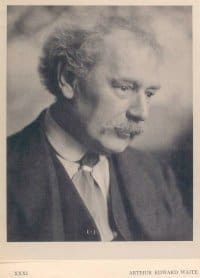
In 1909, Arthur Edward Waite published his own tarot deck without violating the Order’s confidentiality.
Under his supervision, a unique 78-card tarot pack known as the “Rider Deck” was drawn by Miss Pamela Coleman Smith, an American girl who was a fellow of The Order of the Golden Dawn.
This deck became the first commercially available tarot deck in England and was the most popular.
The exceptional feature of the Rider Deck is that all cards are presented in symbolic designs, including the forty pip cards, which are easily useful for divination.
The trump cards in front of The Magician were numbered I to XXI, numberless, designated as 0, for the first letter of the Hebrew alphabet Aleph. The suit symbols of Swords, Wands, Cups and Pentacles were retained as in the Golden Dawn deck.
This transformation of the minor arcana cards from simple playing cards to a powerful symbolic image facilitates the tarot’s role in divination.
Trump’s names largely follow those attributed by Mathers, except for Trump XXI, which becomes World instead of Universe. Waite held the positions of strength and justice at positions VII and XI respectively.
Known as the fifteenth century deck “Solo-Search” The deck (photos of which are in the British Museum) also followed the same design, and it seems likely that Waite and Coleman Smith used it as inspiration.
Do you want to know more about Tarot? Check out our recommendations atTarot BookshelfAnd many free resources at our “Free Tarot Library“
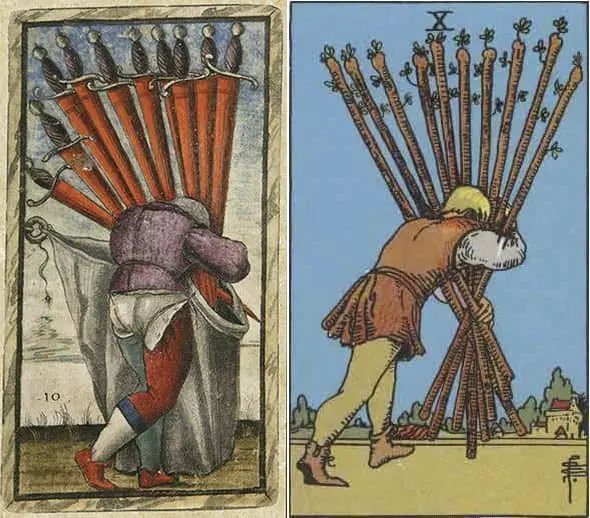
Many of his ideas of symbolism come from the works of Eliphas Levi, Paul Christian, and Pappas. Acknowledging the work of Mathers and Pappas, he wrote: ‘We are the spiritual history of man, or the coming out of the eternal of the soul, passing into the darkness of the material body, and returning to the heights.’
The astrological and Kabbalistic correspondences become apparent in Waite’s deck. These correspondences are identical to those set forth in the Teachings of the Golden Dawn
- In Trump II the High Priestess stepped on a crescent moon.
- On Empress Trump III, there is a heart-shaped shield bearing the sigil of Venus.
- Trump IV, the emperor, had his throne arms surmounted by a ram’s head with the astrological sign of Aries.
Symbolism of Rosicrucianism, roses and crosses are found throughout the trump card.
- In Trump XIII, the figure of Death carries a flag displaying the mystical rose that signifies life.
- At trump 0, the fool holds a white rose in his left hand.
Freemasonry symbols can be found,
- Trump II, High Priestess, on black and white pillar of Zachin and Boaz
- In Trump VII, Chariot, attended by Sphinx.
Christian mysticism and therefore its symbolism was evident throughout the pack.
- In Trump VI, the lover, appears in the figure of Eve.
- Trump XXI, The World, Ezekiel’s appearance of the four living creatures.
The symbolism of the ascension of the soul was evident in the description of the path of the sun which represented the journey of the soul.
In later years, Waite said he did not believe there was a valid correspondence between Trump’s symbol and the Hebrew alphabet. Instead, like WB Yeats, he came to see correspondences between the Tarot suit and the Grail halos or talismans of Celtic myth.
Finally, he linked the Tarot with Celtic mysticism by creating a ‘spread’ or method of laying out the cards which he called ‘an ancient Celtic method of divination’. The spread became known as the ‘Celtic Cross’ and is one of the most popular used for tarot divination.
Related reading: The Hidden Light of Love: How AE Waite Turned Desire into a Divine Mystery – Opens in new tab
Other than France and Britain, elsewhere in Europe there was considerable interest in the tarot as a mystical device.
In Germany, the most famous writer was August Frank Glahn. He published the book “The German Tarot-Book: Divination/Astrology/Wisdom, Three Levels of Initiation” in 1924, which was very popular and sold with a packet of tarot cards designed by Hans Schubert of Reinfeld.
In Russia, French occultism was very popular at the beginning of the 20th century.
Gregory O. Mebes lectured extensively on the Tarot, and in 1912, these lectures were published as a book, “Course on an Encyclopedia of Occultism”, the term ‘encyclopedia’ referring to the Tarot.
The most influential Russian Tarot writer was Pyotr Demyanovich Ouspensky. His book “The Symbolism of the Tarot” was published in 1912, but fifteen years later he revised his ideas and published a new book “A new model of the universe“(Aff.link) In this book, Ouspensky analyzes some of the old ideas and tries to explain them in the light of modern discoveries and ideas.
Another notable Russian writer was Mouni Sadhu, who wrote: “The Tarot: A Contemporary Course of the Quintessence of Hermetic Occultism”(Aff.link), published in 1962 and still in print today.
In America, Gupta society had its own development, with its own societies, magical orders, and American branches of European esoteric institutions. Tarot was an integral part of this magical environment, with several notable books and decks produced.
But, although there were great writers (their material derived primarily from the Golden Dawn), their influence on the development of the Tarot was not as significant as that of the British occultists.
Do you want to know more about Tarot? Check out our recommendations atTarot BookshelfAnd many free resources at our “Free Tarot Library“
The Hermetic Order of the Golden Dawn has proven to be highly influential in all contemporary tarot systems. Tarot decks created by Arthur Edward Waite and Aleister Crowley, both from the Golden Dawn tradition, remain extremely popular.
Many of the occult traditions of Victorian England that influenced the basic teachings of the Golden Dawn remained popular and characterized the New Age movement.
With the New Age movement, the Tarot evolved once more. Its prophetic role has changed, and where it was once used to tell the future, the New Age has shifted to self-transformation and healing.
As with earlier periods in history, symbolism reflects many of the ideas represented by the New Age movement. Once again the Tarot became an integral part of this environment.
Tarot symbolism, especially the Major Arcana, has grown to include many new cultures, alternative healings, methods, and sciences reflecting the trends of this new movement.
As a result, new tarot decks have emerged, viz
- feng shui tarot,
- astrological tarot,
- Buddhist Tarot
- Feminist Tarot
- Environmental Tarot
- Alchemical Tarot
- Ceremonial Magic Tarot
Most modern users of the Tarot are completely unaware of its origins in the courts of northern Italy. It started its life as a game, for entertainment purposes only. It had no secret knowledge or wisdom, nor could it provide guidance for the future.
However, the history of the tarot is interesting. Despite its humble origins, it underwent a radical transformation and transformed from a game to an integral element in the evolution of Guptas and Gupta societies.
The use of tarot as a fortune-telling method is confusing with many different opinions, but its value as an occult tool is generally accepted.
If you want to study the history of the Tarot in detail, I strongly recommend Helen Farley’s work.”A Cultural History of the Tarot – From Entertainment to Mysticism”. (aff.link)
(Also read: The best tarot book for all occult students)
Featured image by Pixabay.
bibliography