
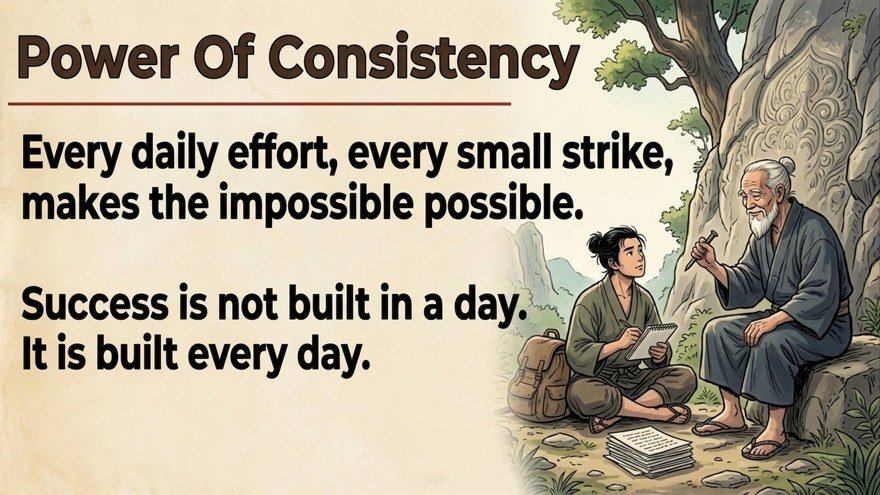

Every successful person knows that secret: strength of consistency. Have you ever wondered why some people reach their goals while others keep starting? We often wait for a “spark” of inspiration or a “perfect moment” to strike, but the truth is much simpler.
in between Graded Reader The story, we follow a young man named Kavin. Like many of us, Kevin was full of big ideas and bright dreams, but struggled to finish what he started. His life changed the day he realized that success is not about how many times you hit, but how often you are willing to hit.
are you here Improve your English fluency Or to find the drive to chase your own dreams, Kavin’s journey will show you that “impossible” is a word for things that have yet to be worked on every day.
Daily Power
Once upon a time, in a small village, there lived a young man named Kavin. Kavin had a big dream: he wanted to be a famous writer. His head was always full of amazing stories and great ideas.
However, Kavin had a problem. He never finished what he started. One day, he would write two pages of a story, but the next day, he would give up. He later tried to keep a diary, but stopped after only three days. Months passed. His dream was still there, but he was getting nowhere. His work was like a puzzle with missing pieces.
One evening Kavin went to the riverside feeling upset. He saw an old man carving a beautiful shape on a huge stone using a small tool. Kevin was surprised. How can such a small tool change such a hard rock?
“Grandpa,” Kevin asked, “how long have you been doing this?”
The old man smiled. “For an hour every day, for the last two years.”
Kevin couldn’t believe it. “Two years? Aren’t you tired or want to quit?”
The old man looked at him kindly. “Son, this tool alone cannot break stone, it is mine Continuity-my daily effort – to make it happen. Rocks don’t change with just one hit. But every hit counts. It’s not about one big push, it’s about doing it over and over.”
These words changed Kavin’s thinking. He went home and made a simple promise to himself. He would not attempt to write an entire book in one night. Instead, he just wrote One page per dayNo matter what.
At first, it was easy and fun. But soon, he felt lethargic. Some days she was tired, and other days she had no idea. But he remembered the words of the old man: Every hit counts. Even on his worst days, he wrote at least a few lines.
Days turned into weeks, weeks turned into months. The leaves grow. Soon, he had 100 pages, then 200, then 300. One day, Kevin looked at his desk and realized that he had finished his first book!
He has sent his books to many publishers. Many of them said “no”. He began to doubt himself again, but he did not give up. He continued to write. Another page, another story, another try.
After two years of persistent work, a publisher finally accepted his book. People loved his stories. Kavin became famous as the man who reached one page of his dream.
lesson
Success doesn’t come what you do sometimes. It comes from what you do every single day.
As water carves a path through the mountains, your small, steady efforts will create wonders. If you’re feeling inspired today, keep that feeling alive!
If you enjoyed this story:
- like This post.
- Share it It’s with a friend who needs hope.
- Follow up Join us on this growth journey.
Your success is not built in a day. It is built every day.
✅️ Inspirational life lessons from this story
The story of Kavin and Stone Carver provides a powerful blueprint for achieving long-term goals. Here are key life lessons you can take away from it:
1. The power of small gains
We often think that success requires massive, heroic actions. In reality, success results Micro-habits. Writing a page is easy; Writing a book is hard. By focusing only on “one page,” Kevin removes the fear of big tasks and makes progress inevitable.
2. Continuity over intensity
The old man’s chisel was weak, but his schedule was strong.
- intensity Injured running a marathon once.
- Continuity Walking 20 minutes every day for a year. The rock is not broken by the force of the final blow, but by the thousands of blows that came before it.
3. Resistance is normal
Kavin experiences lethargy and doubt after the “honeymoon phase” of his project ends. This is “dive”– The point where most people give up. The lesson here is that you don’t need “motivation” to act; You need one commitment Show up even when motivation is absent.
4. Handling Rejection with a “Growth Mindset.”
When publishers rejected Kavin, he didn’t see it as a permanent failure. He saw it as part of the process. Since he had already mastered the habit of showing up every day, he had the mental strength to stick around and keep writing until he found success.
How to apply it today
Don’t look at the mountains if you have big dreams. Look at your feet.
- Choose a goal.
- Define the smallest possible step (eg, 5 minutes exercise, 10 minutes reading, 1 paragraph writing).
- do it today Even if you are tired, do the “minimum version” of that task.
“Success is the sum of small efforts, repeated day after day.”
How can I help you break down one of your current goals into “one-page” daily tasks?
✅️ Learn English from this story:
This story is an excellent tool for learning English because it uses The narrative is tomorrow To describe the past and provide great examples of it idioms And Vocabulary related to habit.
Here is a breakdown of the original English text of the story:
1. Basic vocabulary and phrasal verbs
Understanding these words will help you describe your own goals and routines.
- stuck (something): To continue doing something without stopping.
- Example: Kavin couldn’t stick to His writing plan.
- Quitting/abandoning: Stop doing something because it’s too hard.
- Example: Don’t give up on your dreams
- Continuity: Do the same regularly to get results.
- To crawl: To begin to happen or affect something slowly and imperceptibly.
- Example: Doubt begins to crawl After the first week.
- Engraving: Forming a shape by cutting a solid material (such as stone or wood).
2. Using “will” for past habits
In the story, we see this sentence: “One day he will be Write two pages… The next day he will be exit.”
In English, we use would + verb To talk about repeated actions or habits in the past. This is similar to saying “used to”.
- Composition: Subject + would + base verb.
- Example: Every morning, the old man have to go near the river
3. Idioms and Figurative Language
The story uses “word pictures” to explain deep feelings.
- “Overflowing with imagination”: There are so many ideas that you cannot contain them.
- “Scattered like a puzzle piece”: Used to describe something that is messy, disorganized or incomplete.
- “Every strike counts”: Every small effort is important and adds up to a big result.
- “One page at a time”: A way of saying you should focus on small steps instead of a grand end goal.
4. Practice practice
A. Synonyms Match:
Try to find a word in the story that has a similar meaning:
- very surprised (shocked)
- not finished (incomplete / unfinished)
- A small, steady effort (Continuity)
b. Sentence Completion:
Fill in the blanks using the theme of the story:
- “If you want to be a writer, you must write _________ ____________.” (Answer: Every day)
- “Kevin learned that his success was not made in _________.” (Answer: day)
5. Pronunciation tip: “ch” and “s” sounds
Such words are used in the story Chisel ($/ˈtʃɪz.əl/$) oath stone ($/stoʊn/$).
- Practice hard “f” in Chisel And change.
- Practice smooth “S” in stone, steadyAnd success.
Would you like to try writing a few sentences about your daily goals using the new vocabulary available today?
Frequently Asked Questions (FAQ)
1. What is the main lesson of the story? The key lesson is that success comes ContinuityNot just the occasional intensity. Like the stone carving old man, it’s the small, daily efforts that make the impossible possible.
2. Why was the name of the character changed to Kavin? In order to simplify the English and update the content, the character was renamed Kavin Providing a new perspective for the reader while maintaining the main message of the story.
3. How does this story help in learning English? This story works as one Graded Readerwhich uses simplified language to help students improve their fluency. It introduces key vocabulary such as “consistency,” “creeping in,” and “stick to” and shows how to use past participle structures such as “would + verb.”
4. What was the “Chisel’s Law” mentioned in the video intro? A metaphor for “Chisel’s Law”. Daily effort. It teaches that a solid target (rock) is not shaped by one large blow, but by the repetition of many small, steady blows over time.
5. How did Kavin overcome his habit of giving up? Kevin stopped trying to finish a whole book at once and instead created one small promise Write only one page per day. By focusing on these manageable daily tasks, he managed to complete a 300-page book.
6. What should I do when I feel unmotivated or tired? According to the story, you should remember this Every strike counts. Even on the hardest days, doing a “minimal version” of your work—like writing just a few lines—keeps your momentum going and builds your success.
Conclusion: Build your success, one page at a time
Kavin’s story reminds us that greatness is a slow process. Just as an old man’s chisel shapes solid rock, your daily habits are currently shaping your future. You don’t need to write an entire book today; You just have to write one page. You don’t need to be fluent in English tomorrow; You just have to learn A new phrase today
Important ways for your life:
- Continuity on Intensity: Small, daily efforts are more powerful than occasional bursts of energy.
- Each strike counts: Even on days when you don’t feel inspired, doing the “minimum” keeps your dreams alive.
- Don’t fear rejection: Like Kavin, use each “no” as a reason to continue writing your next chapter.
Success is not something that happens to you overnight; It’s something you build every single day.
What is your “one page” for today? Let us know in the comments below!